

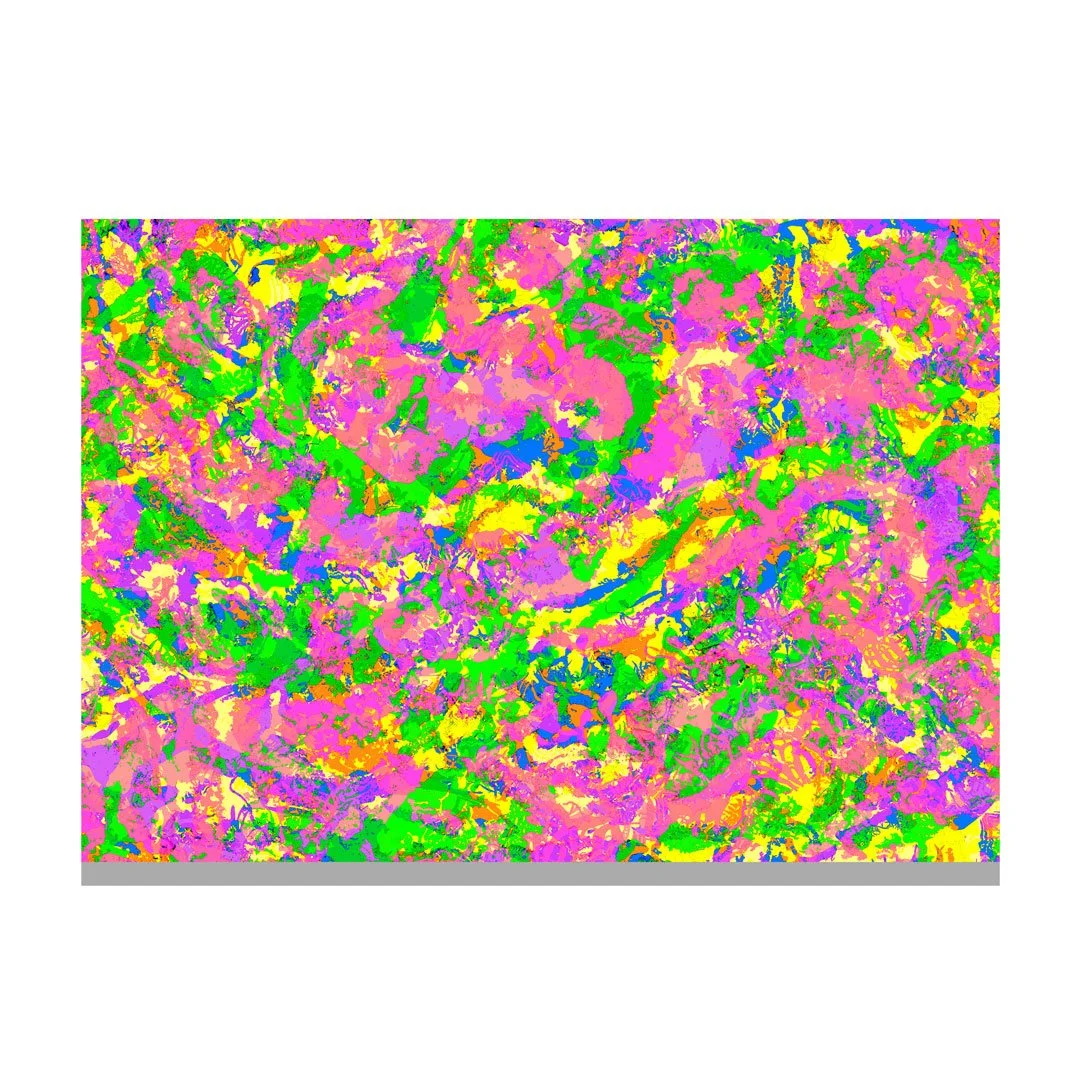
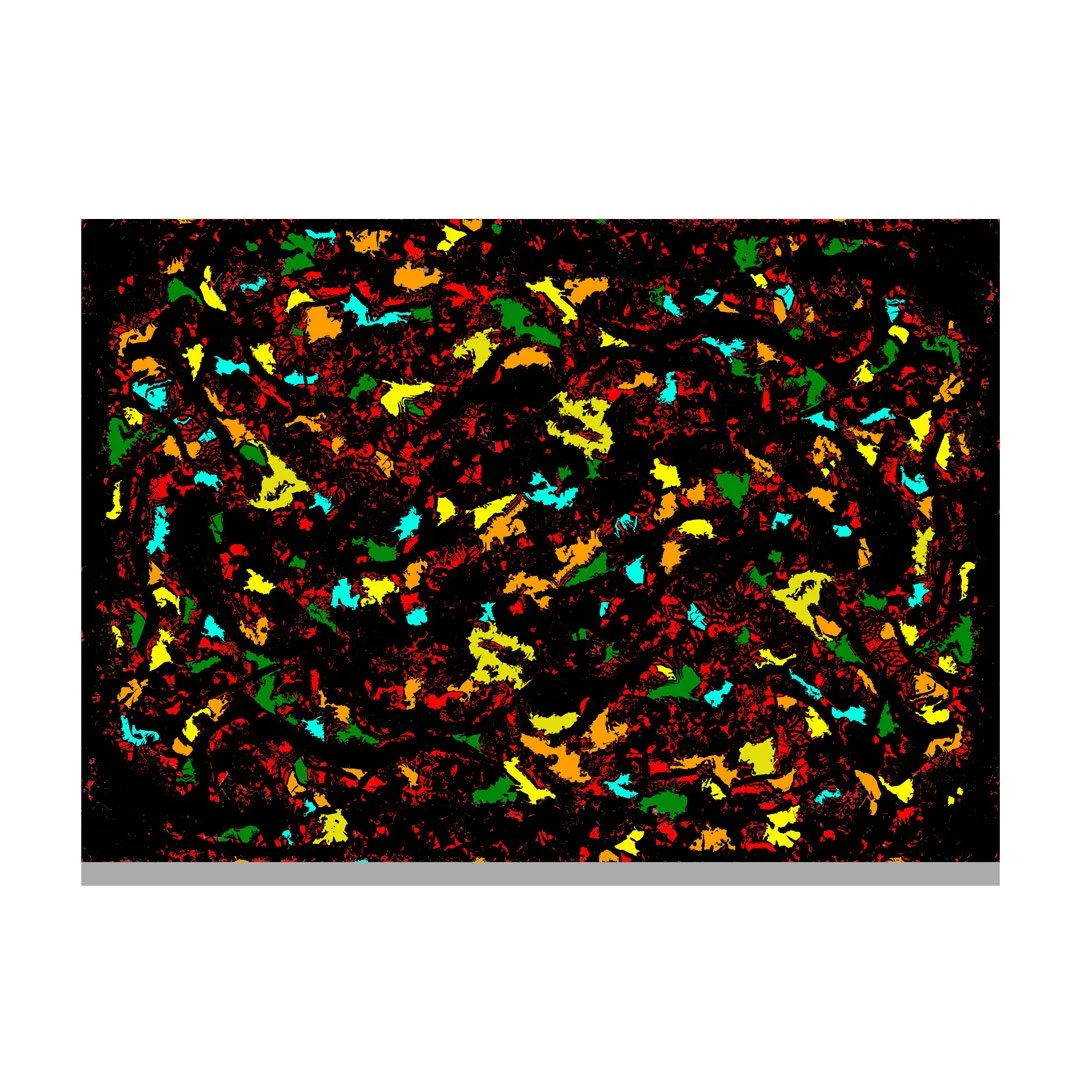
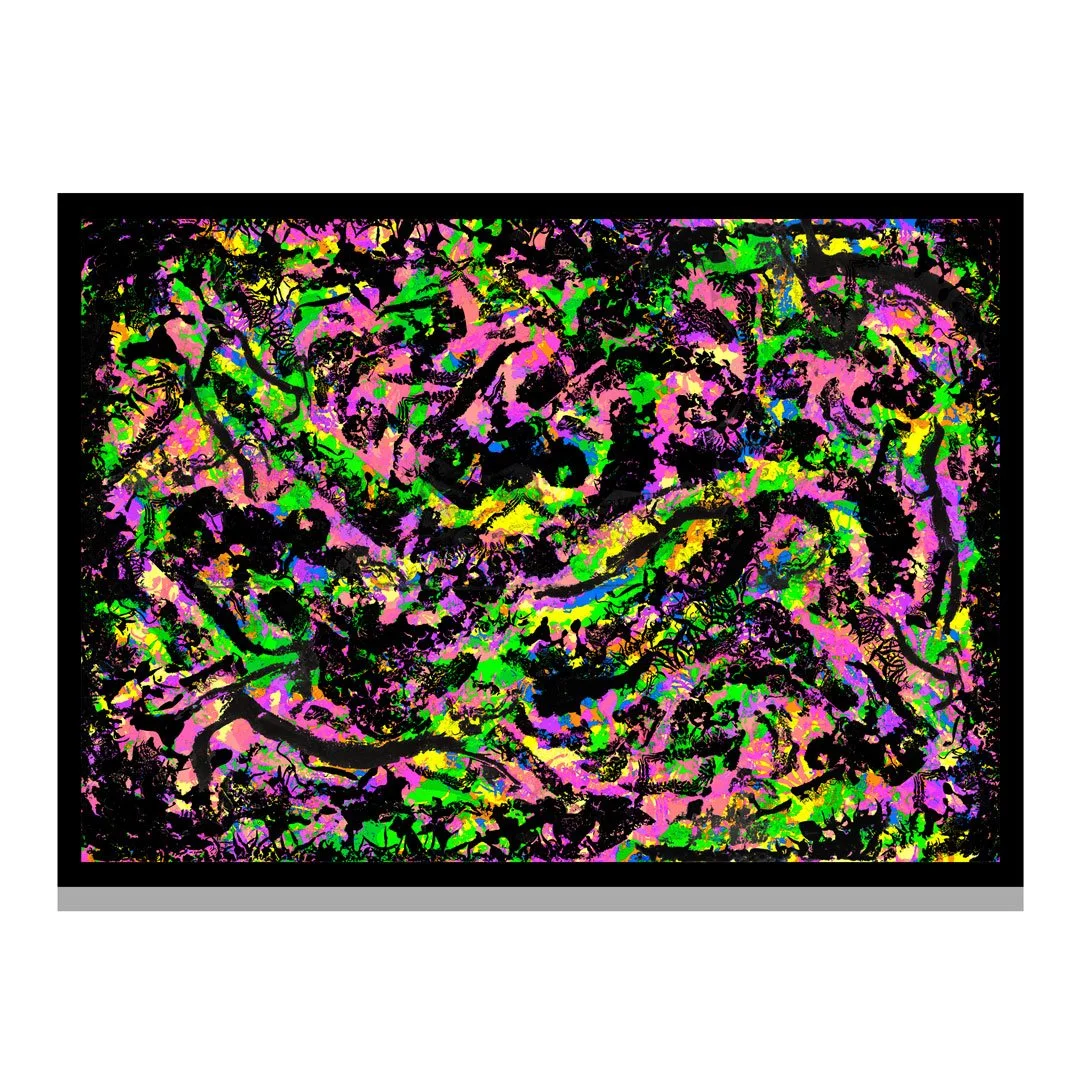
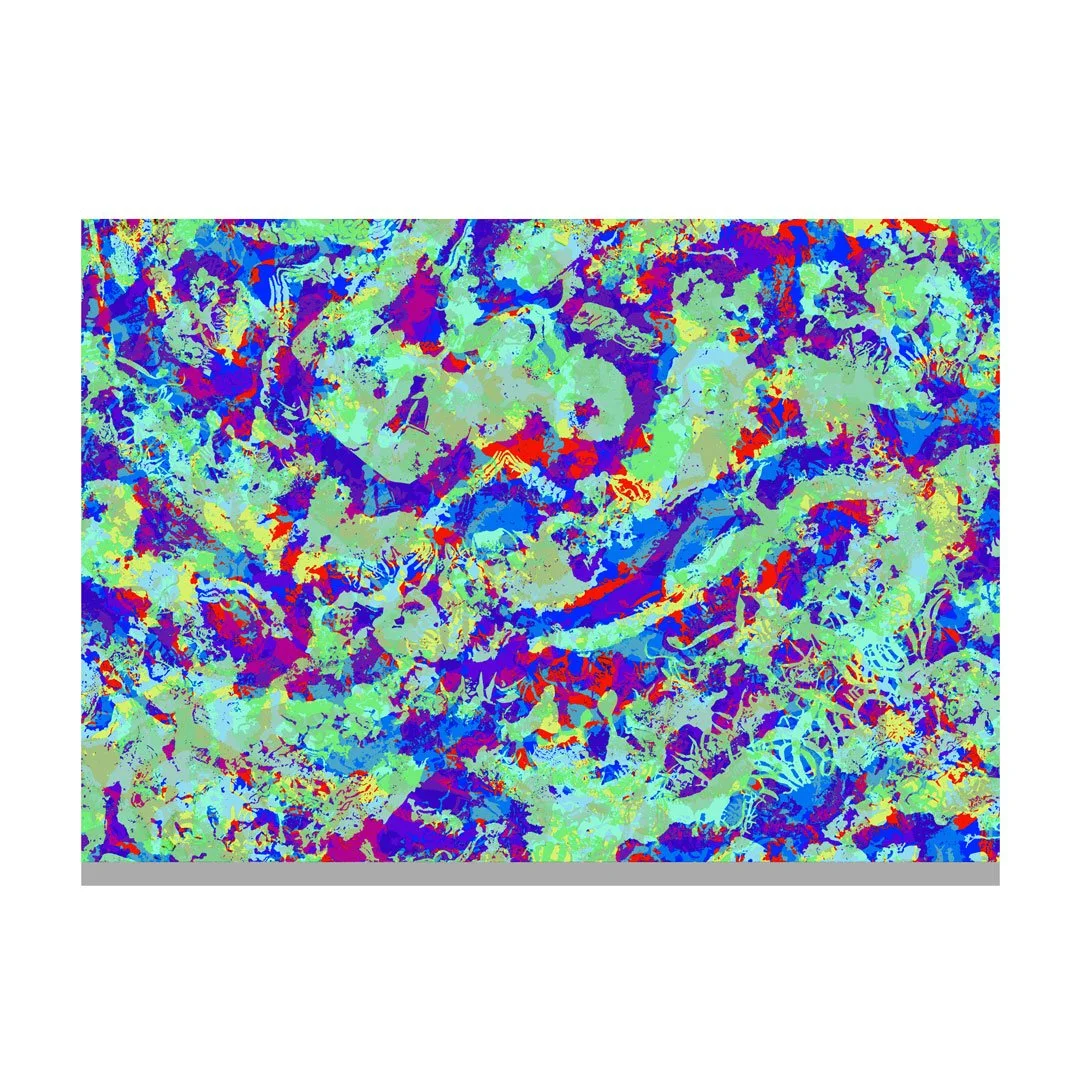
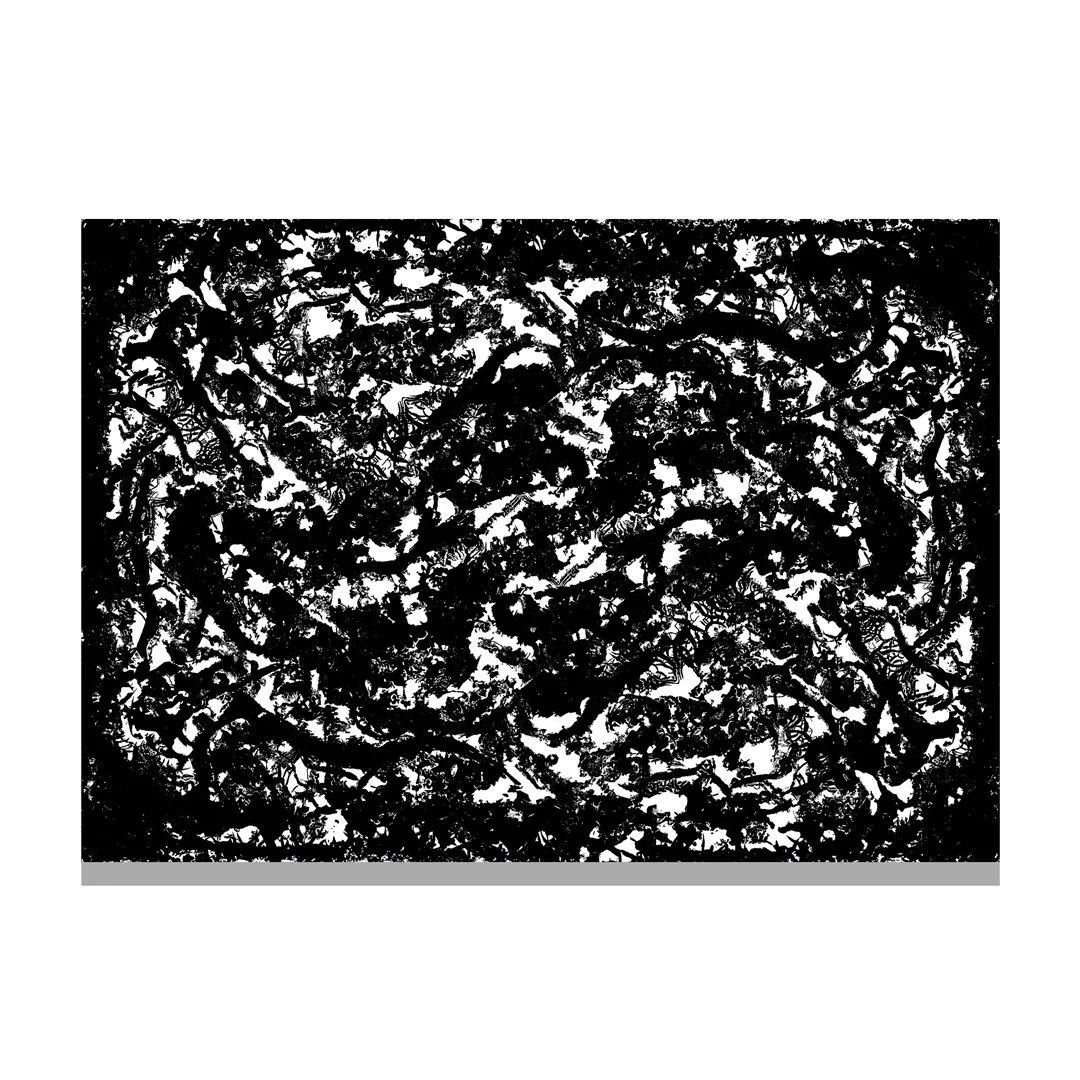
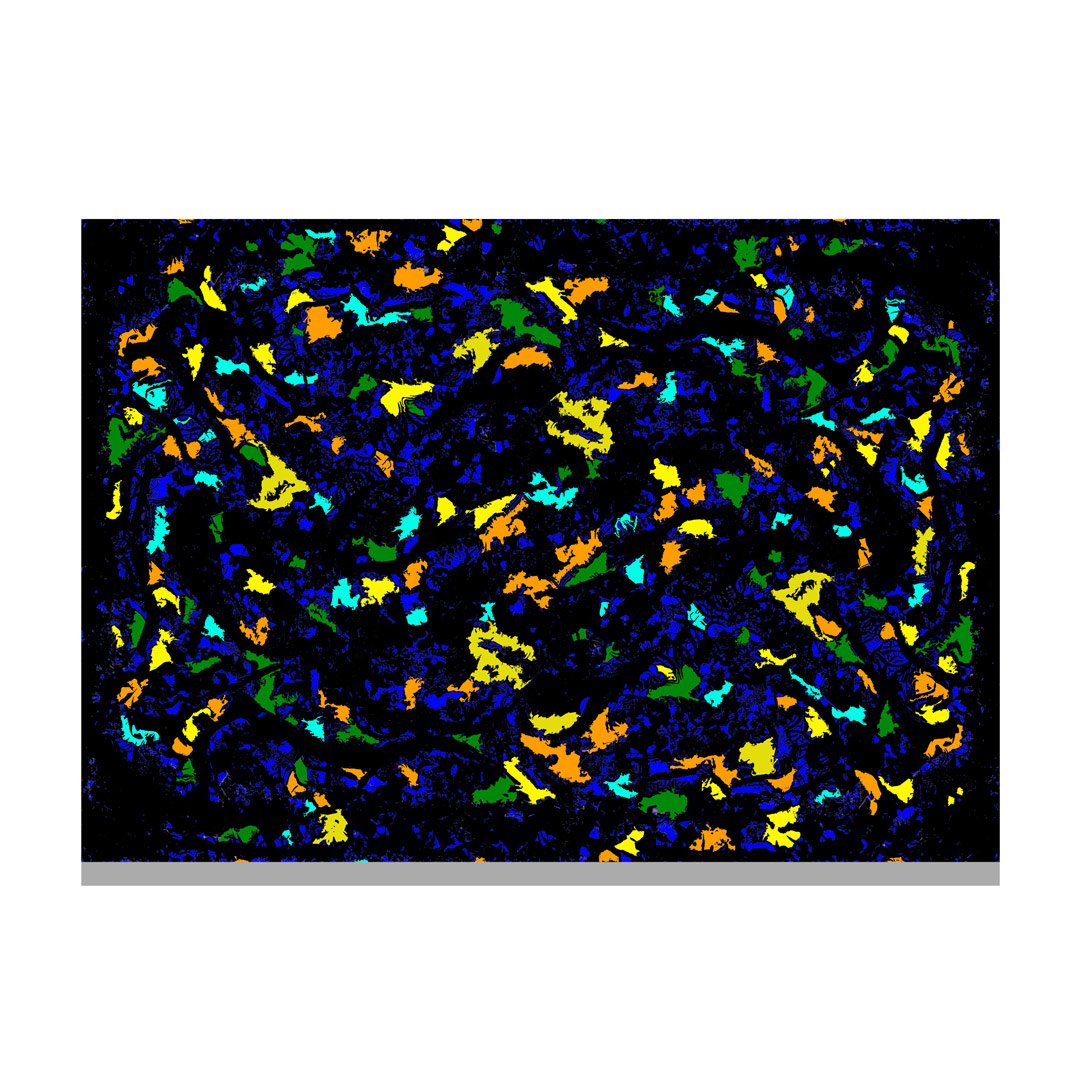
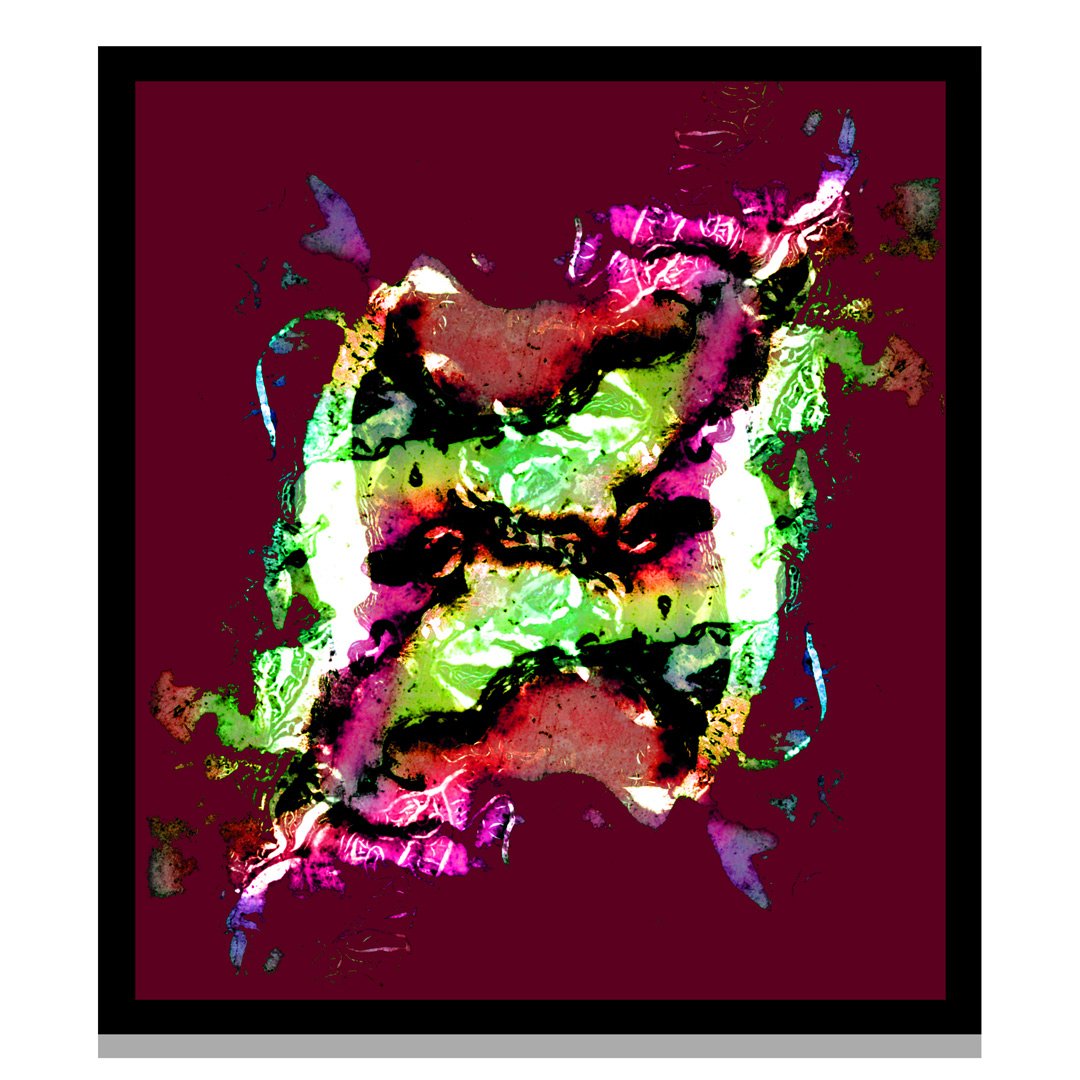
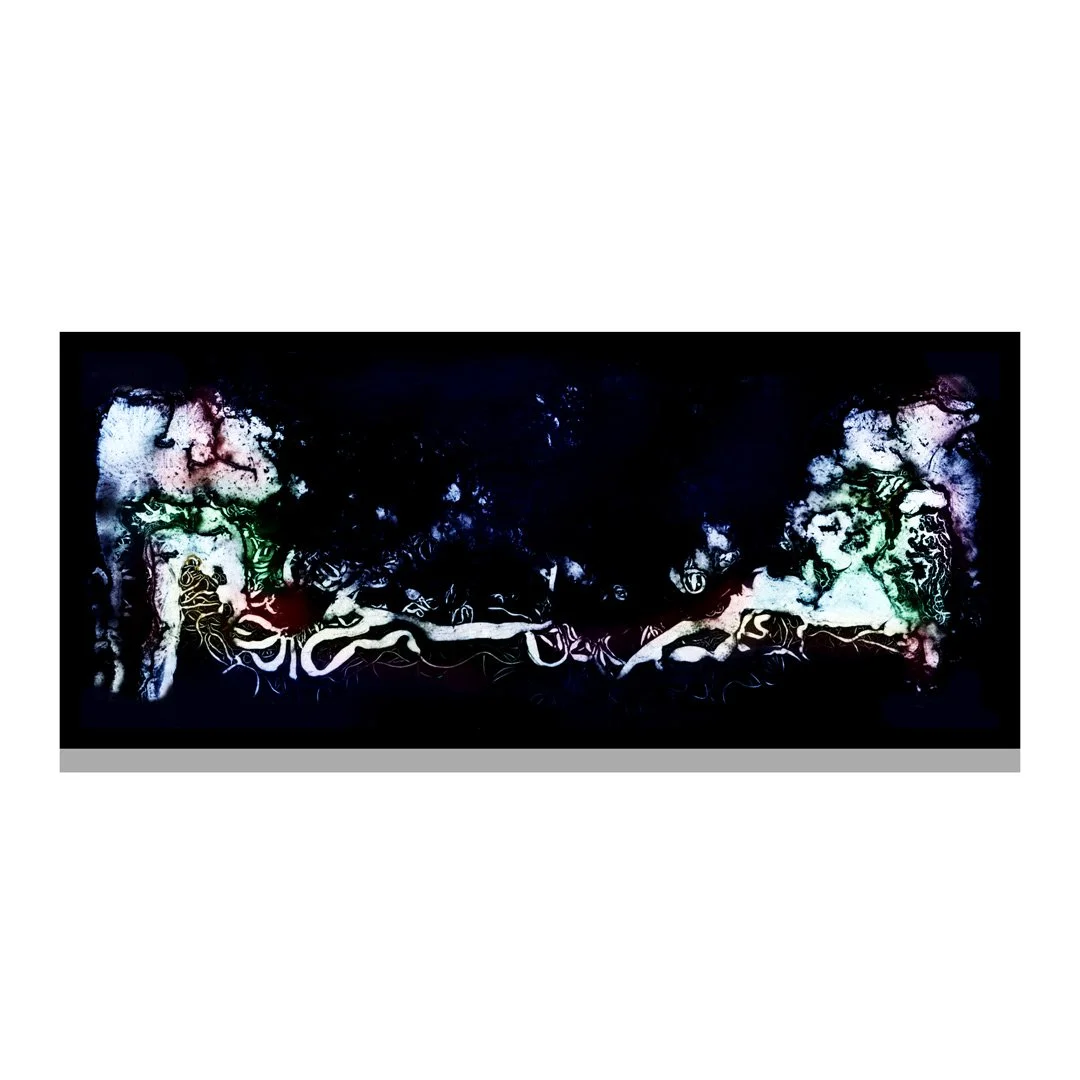
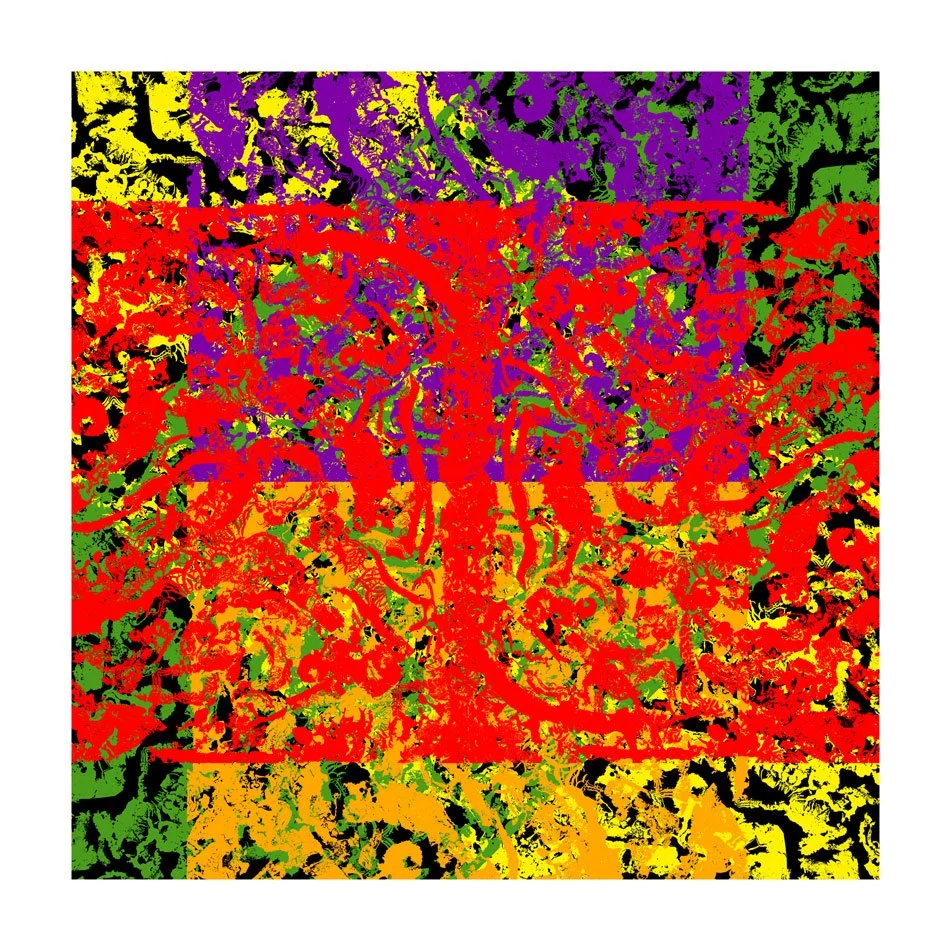
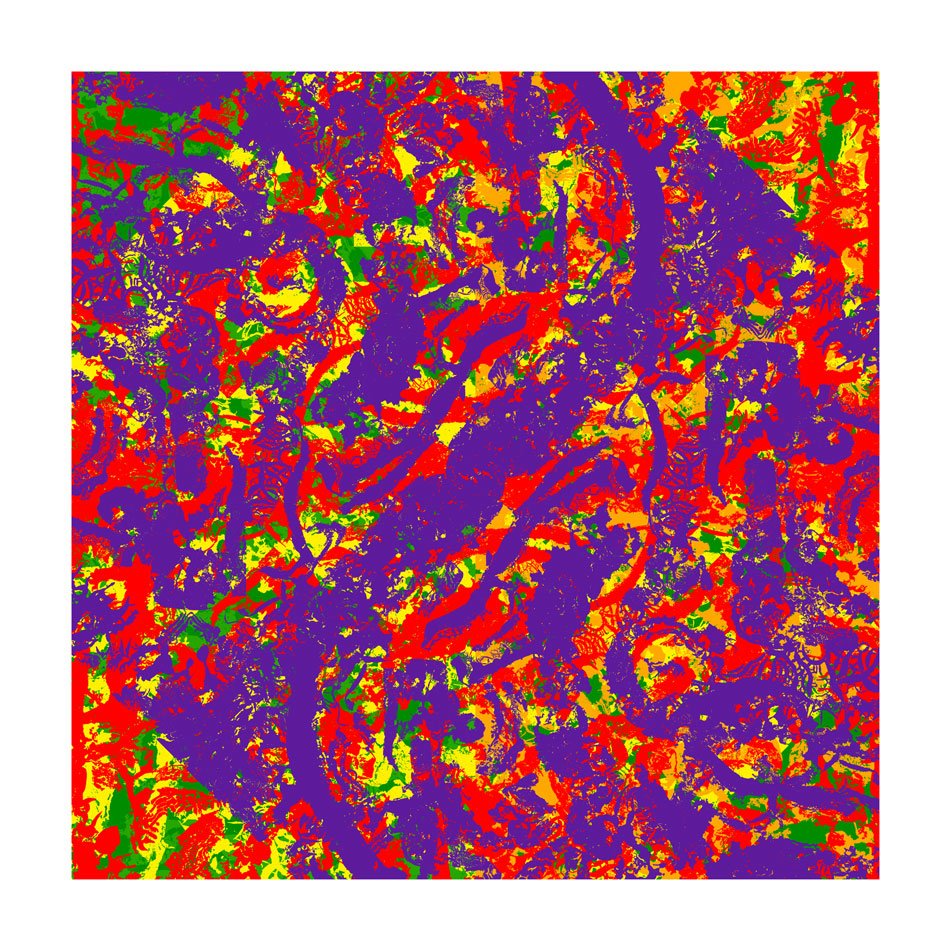
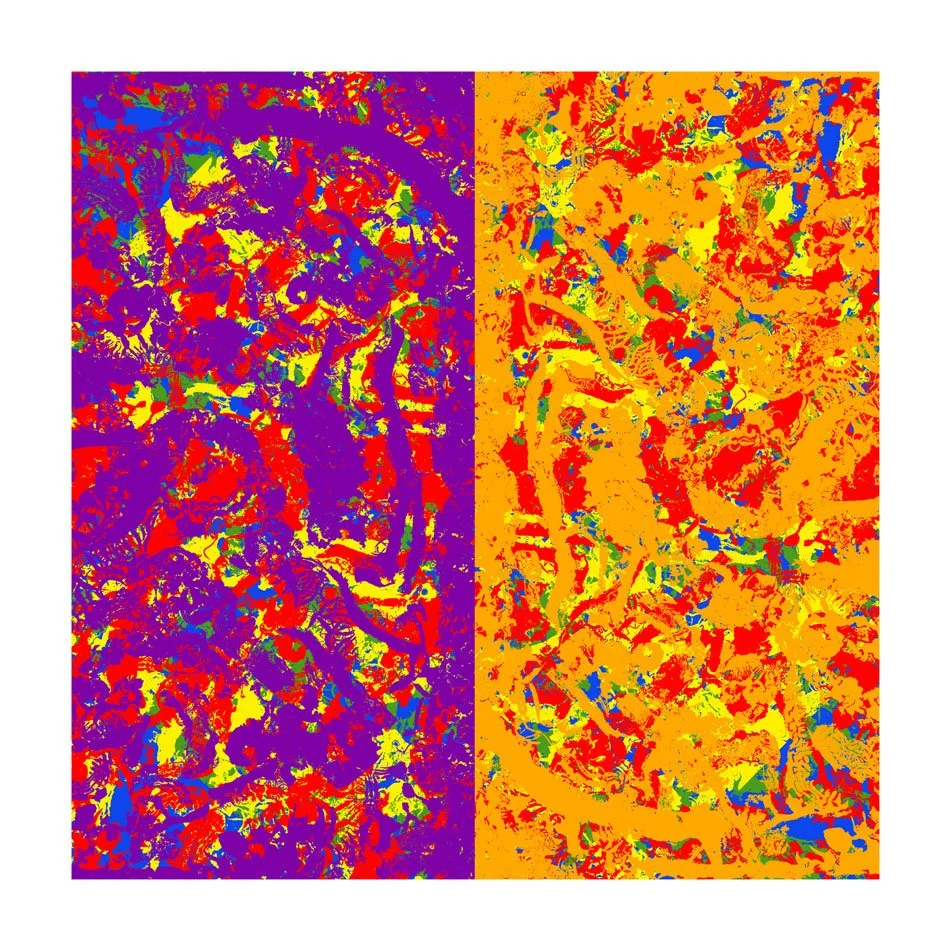
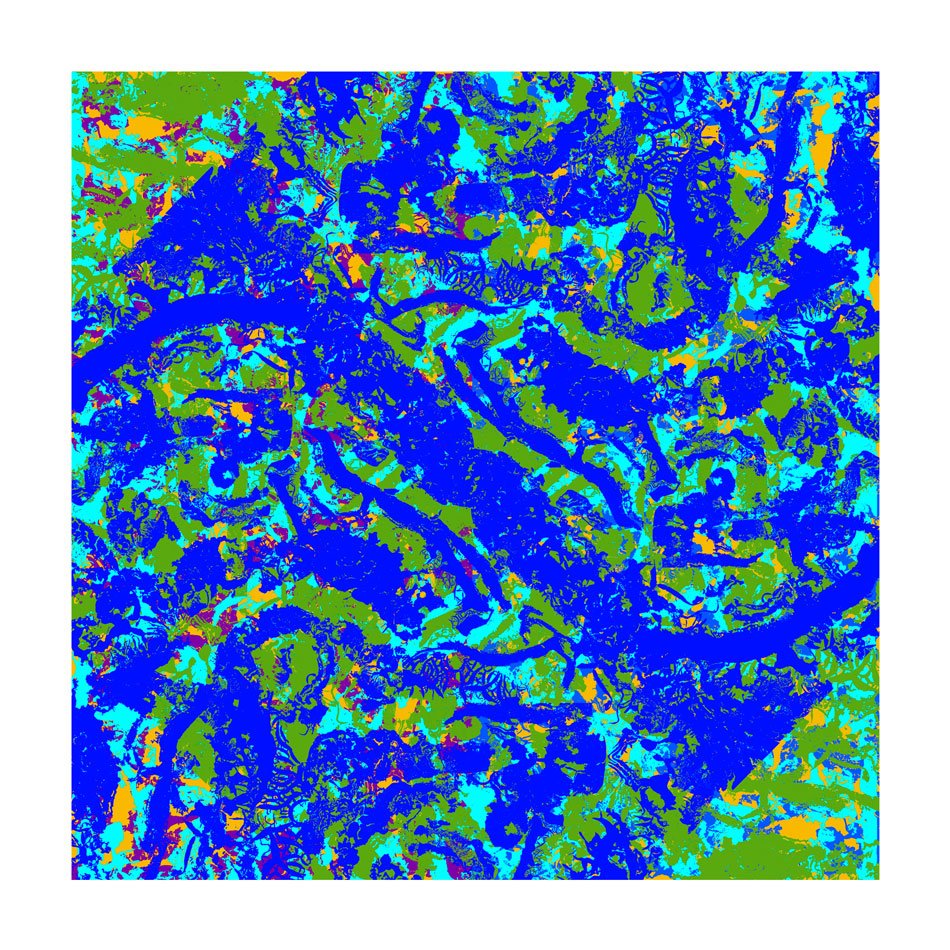
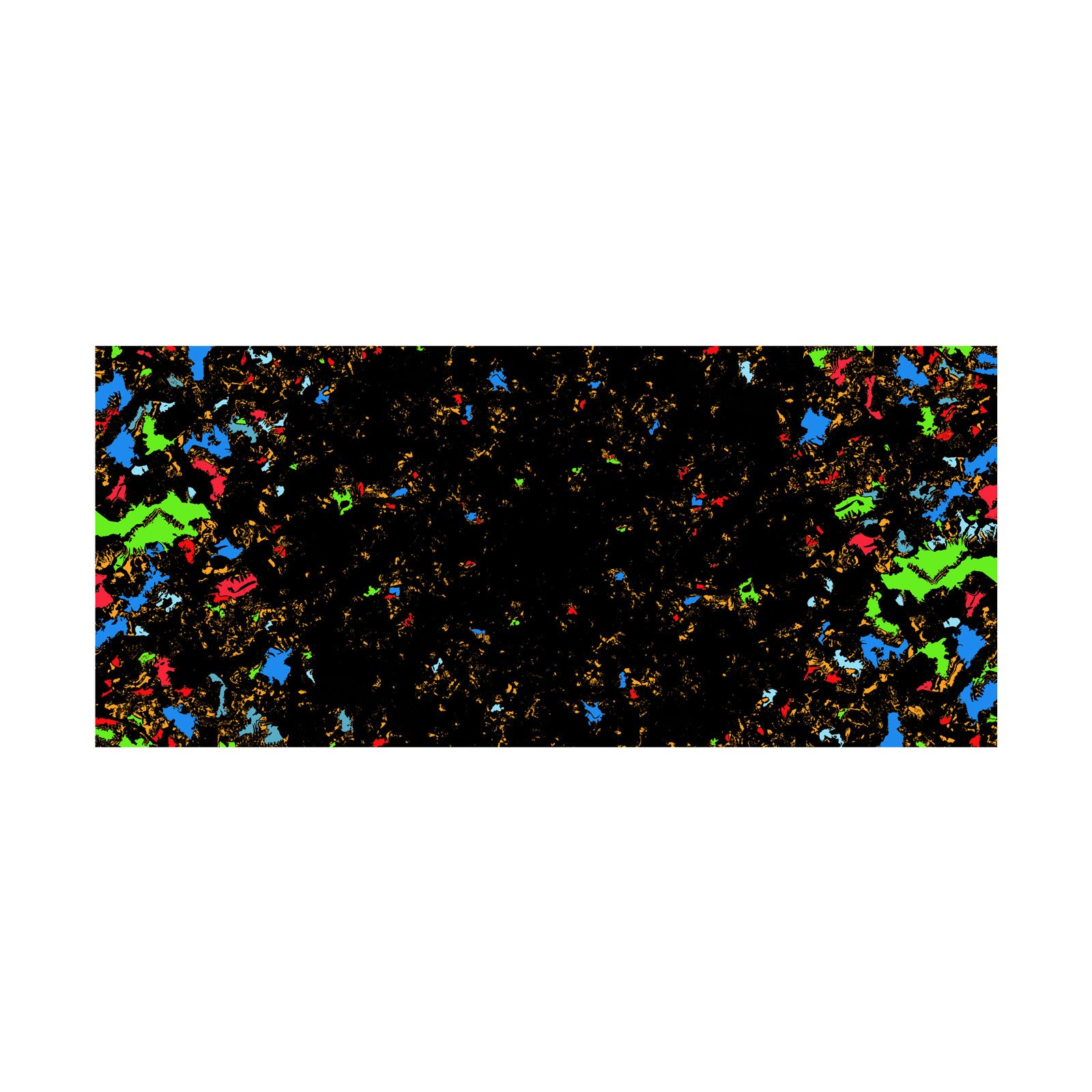
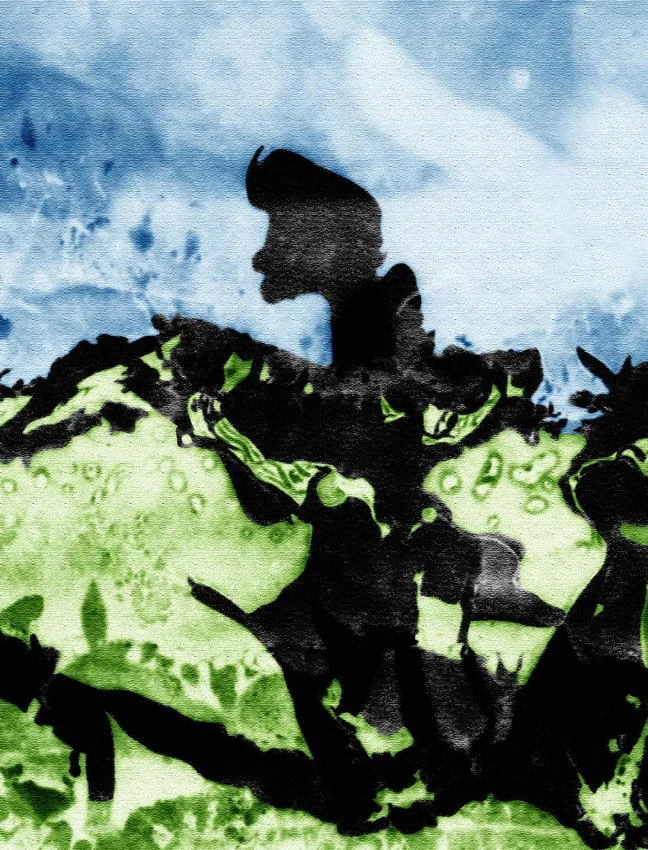
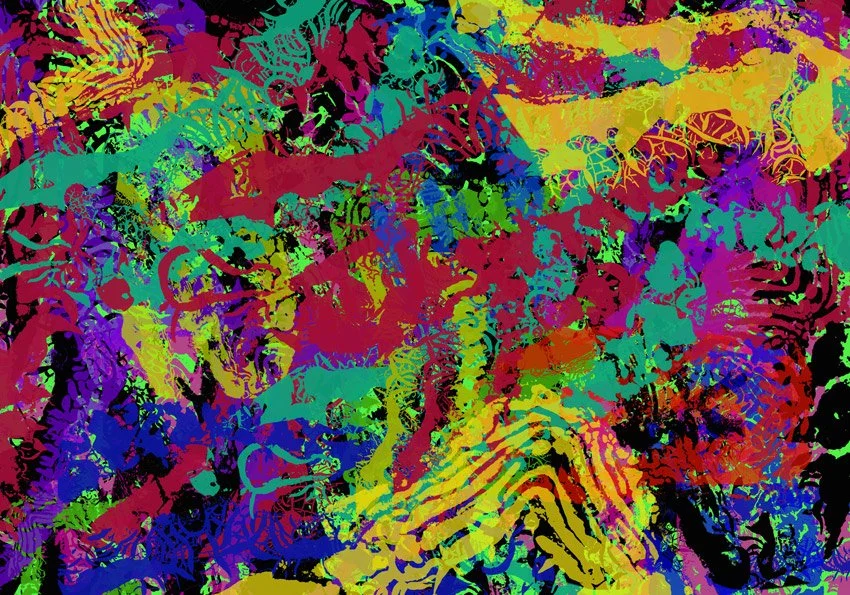
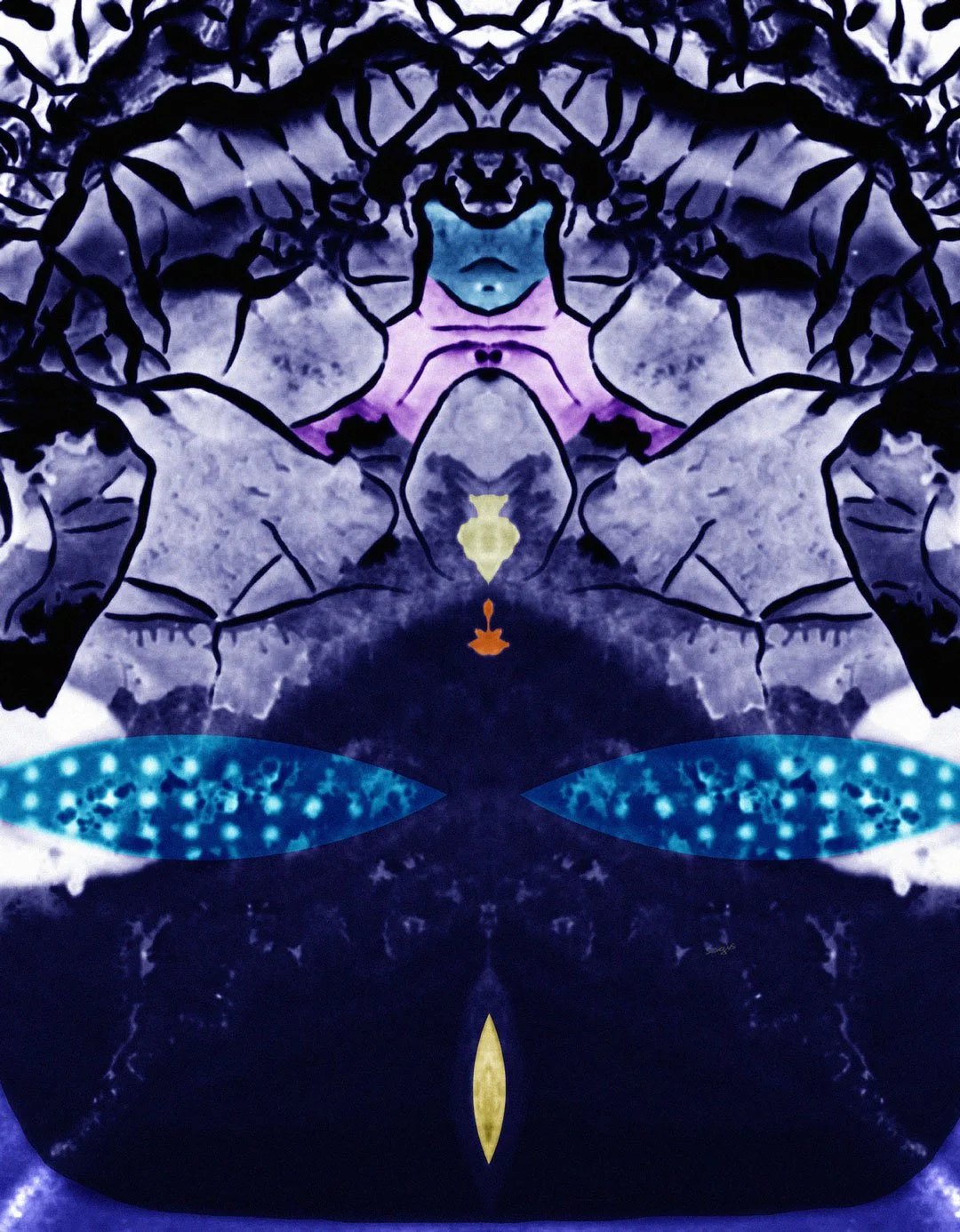
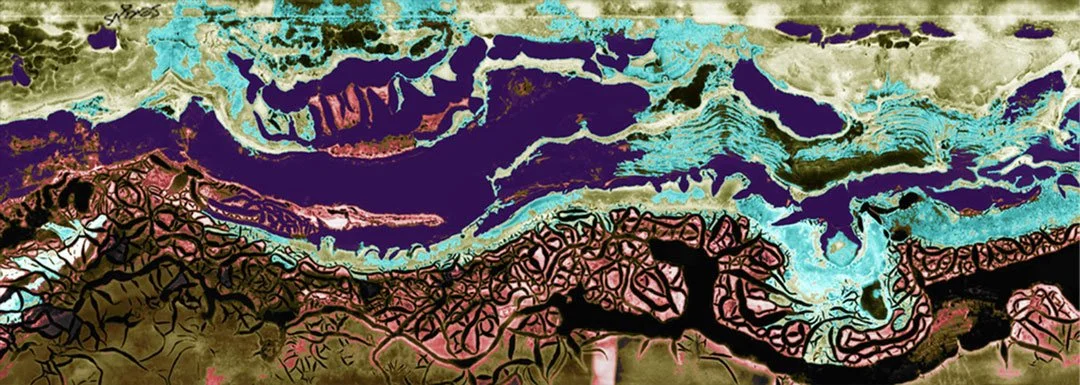
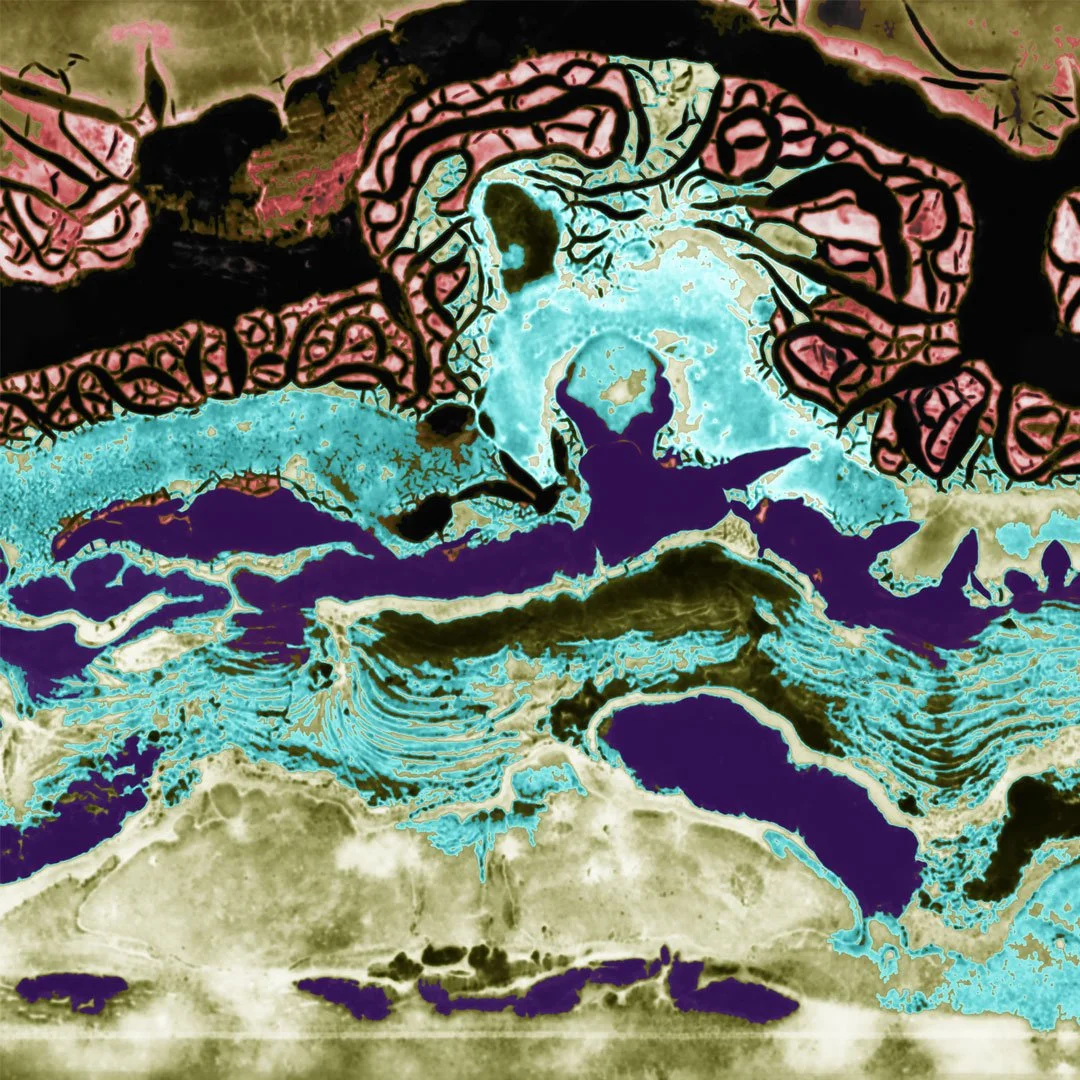
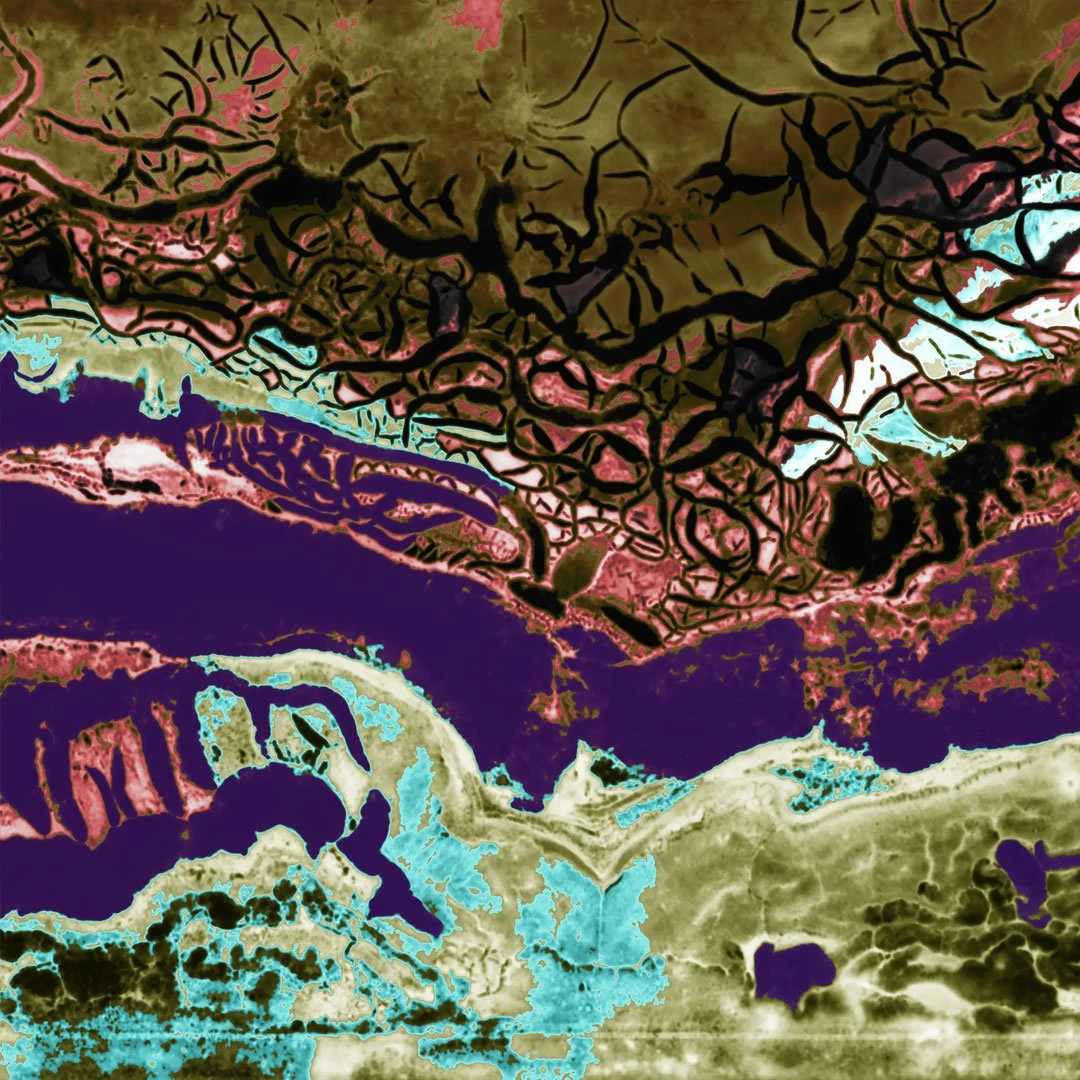
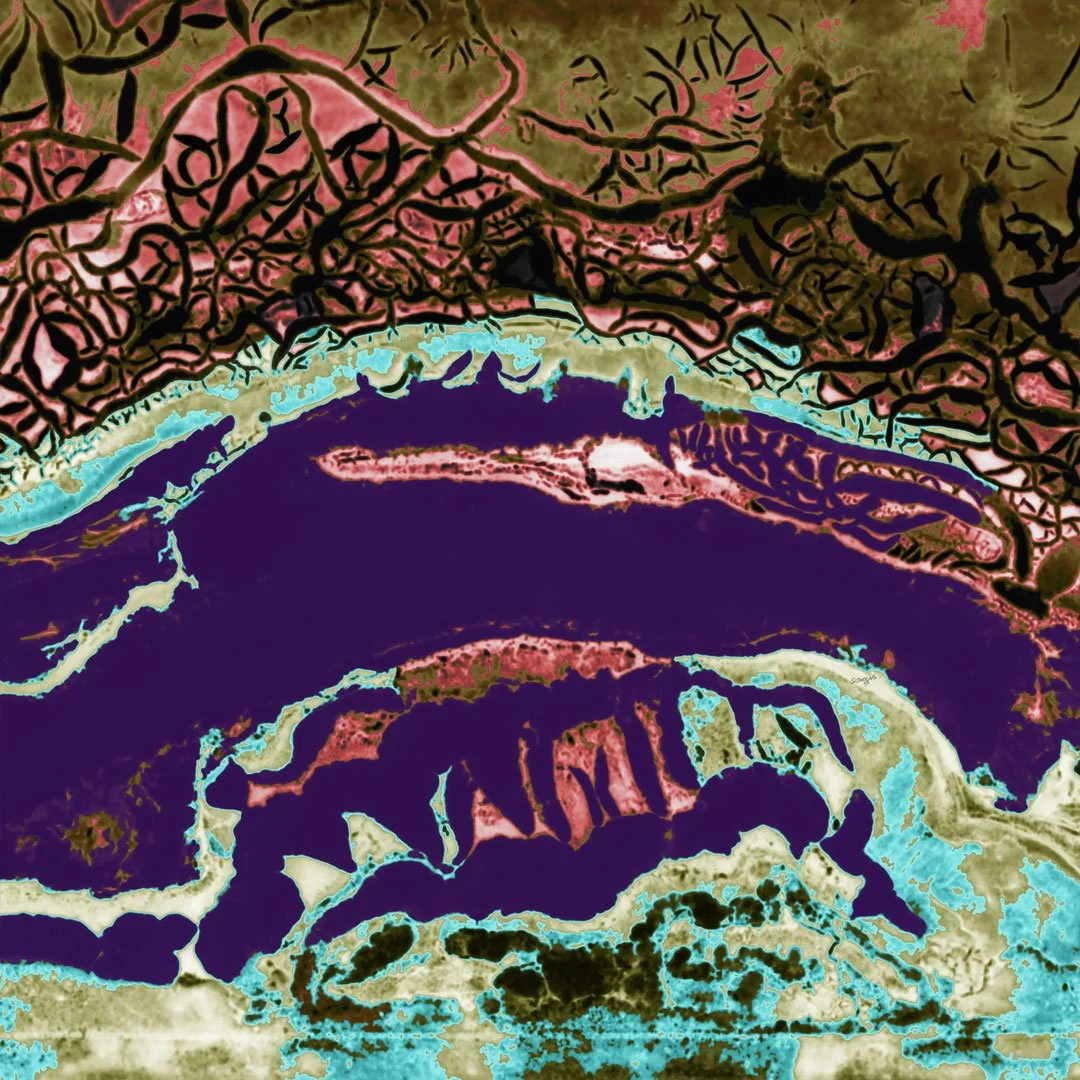
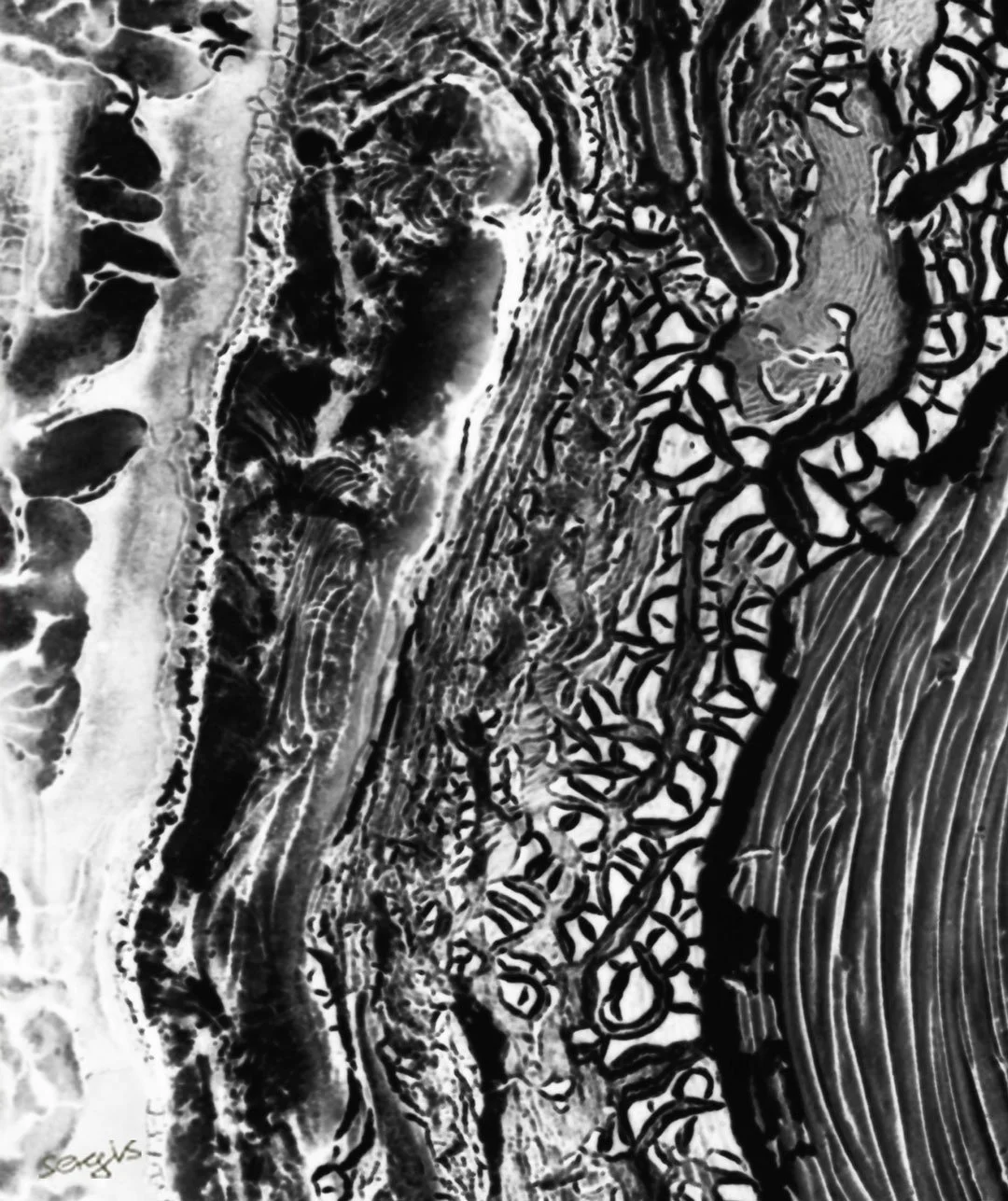
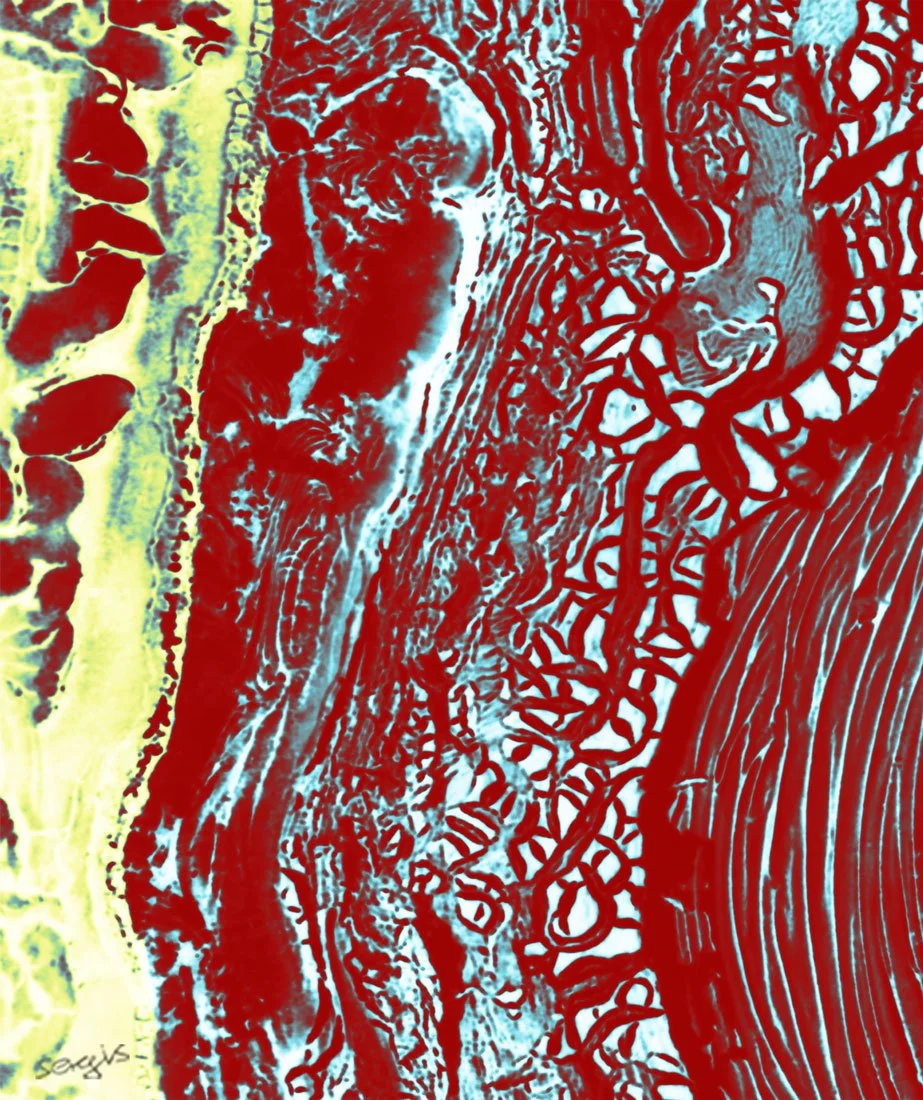
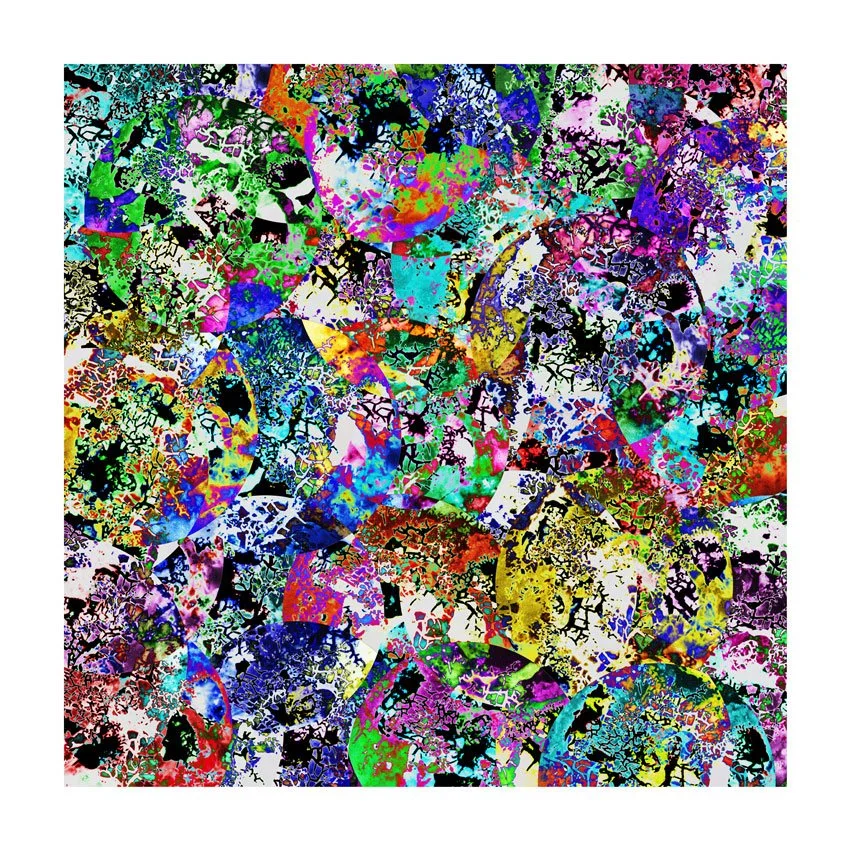
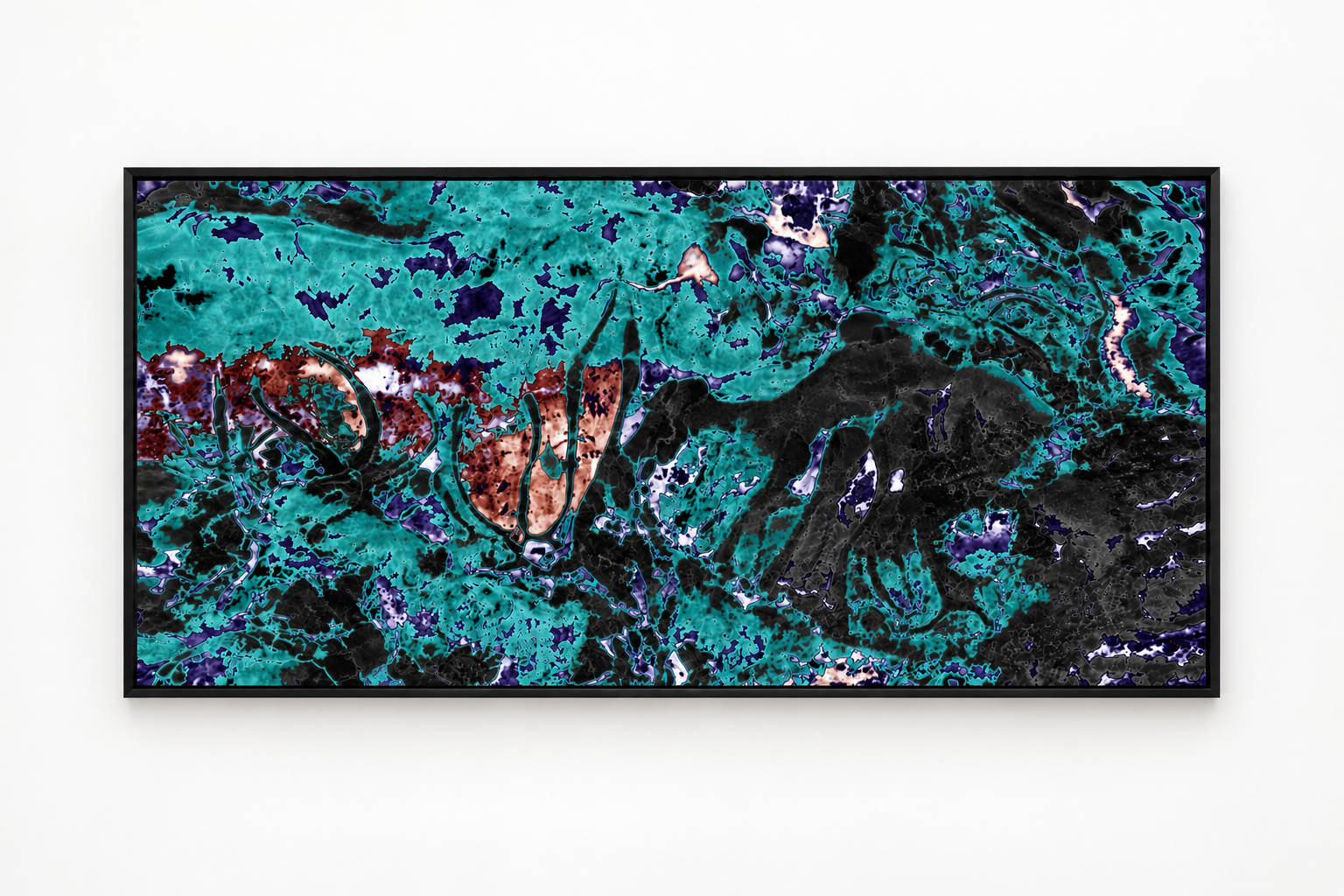
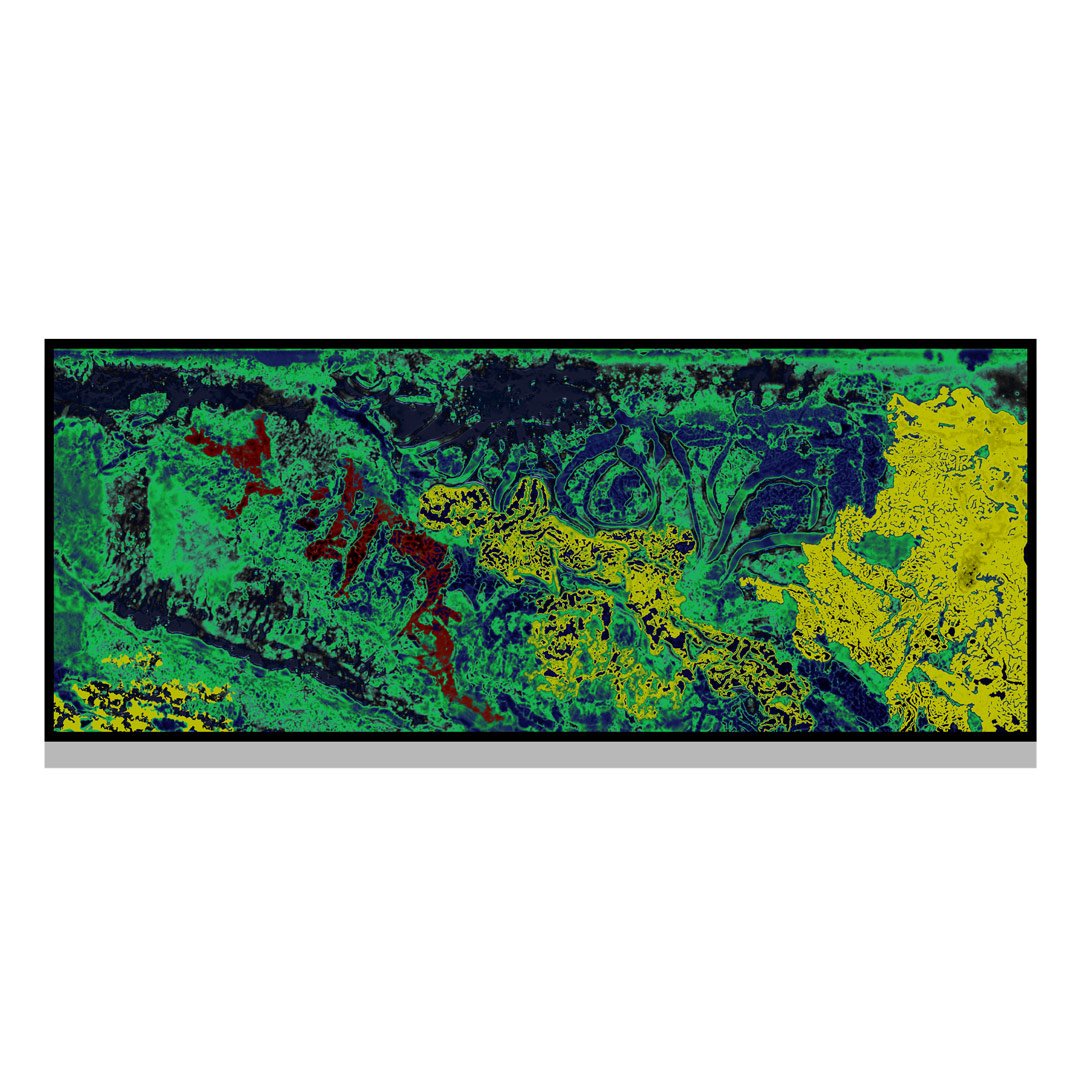
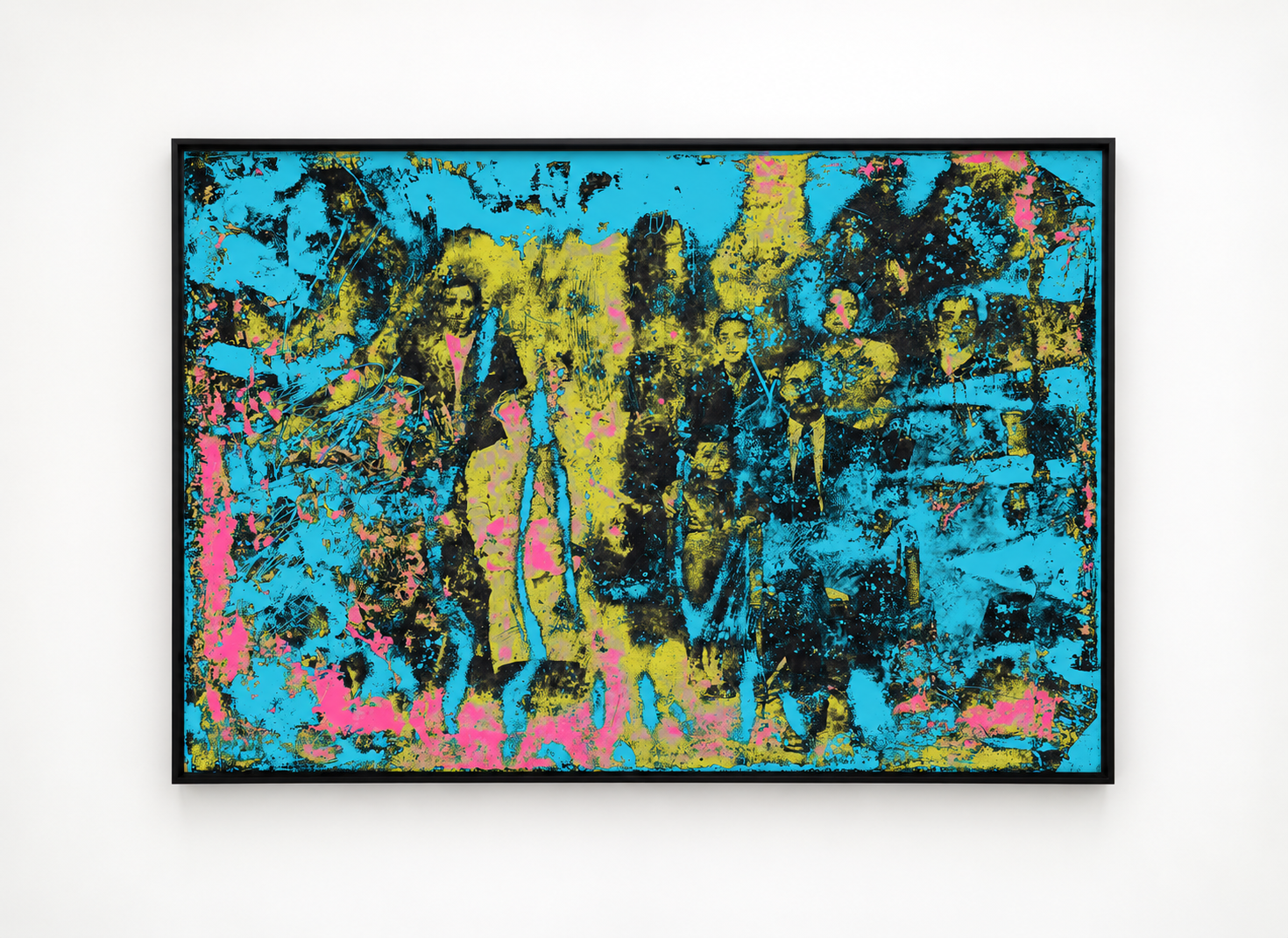
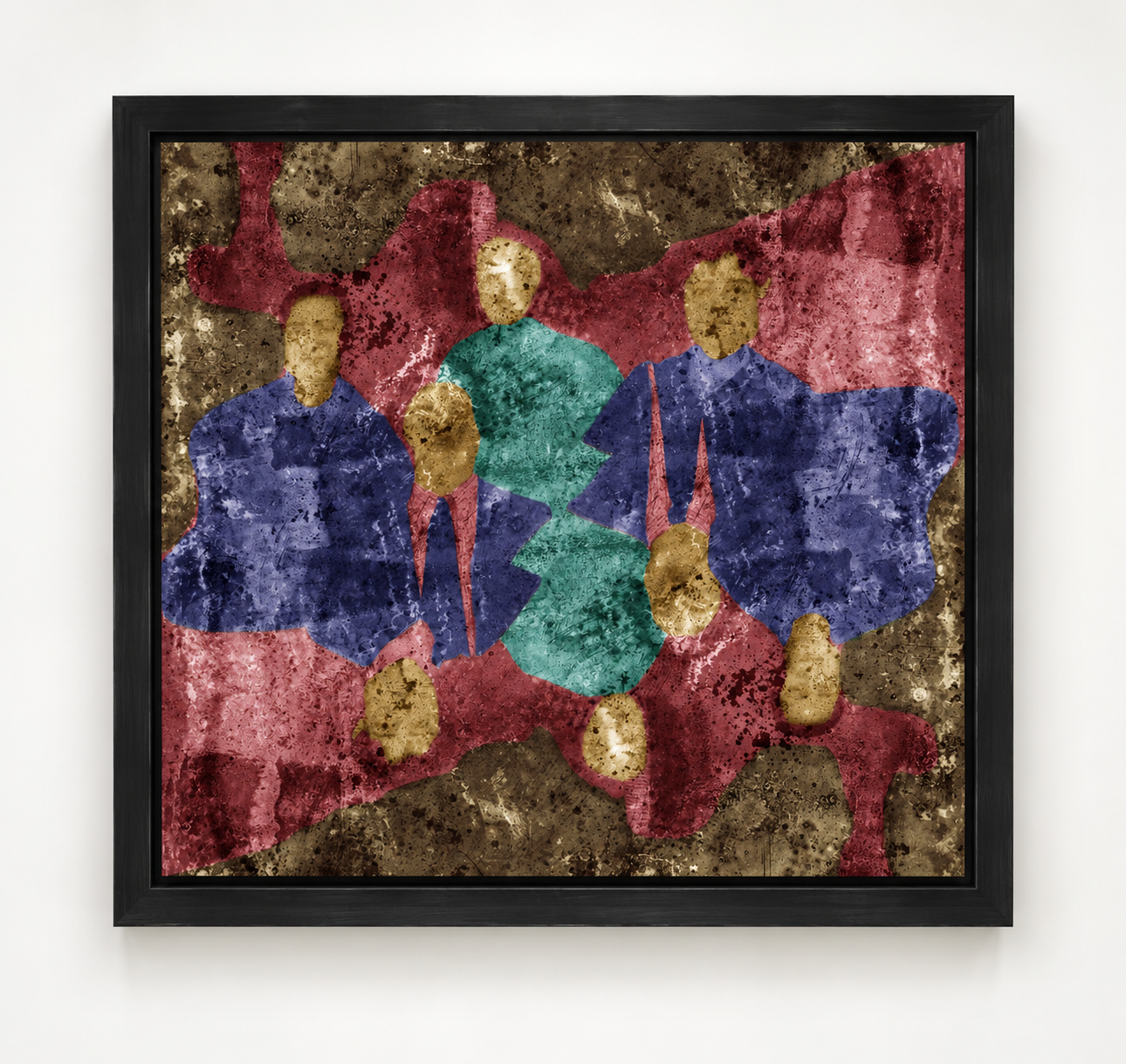
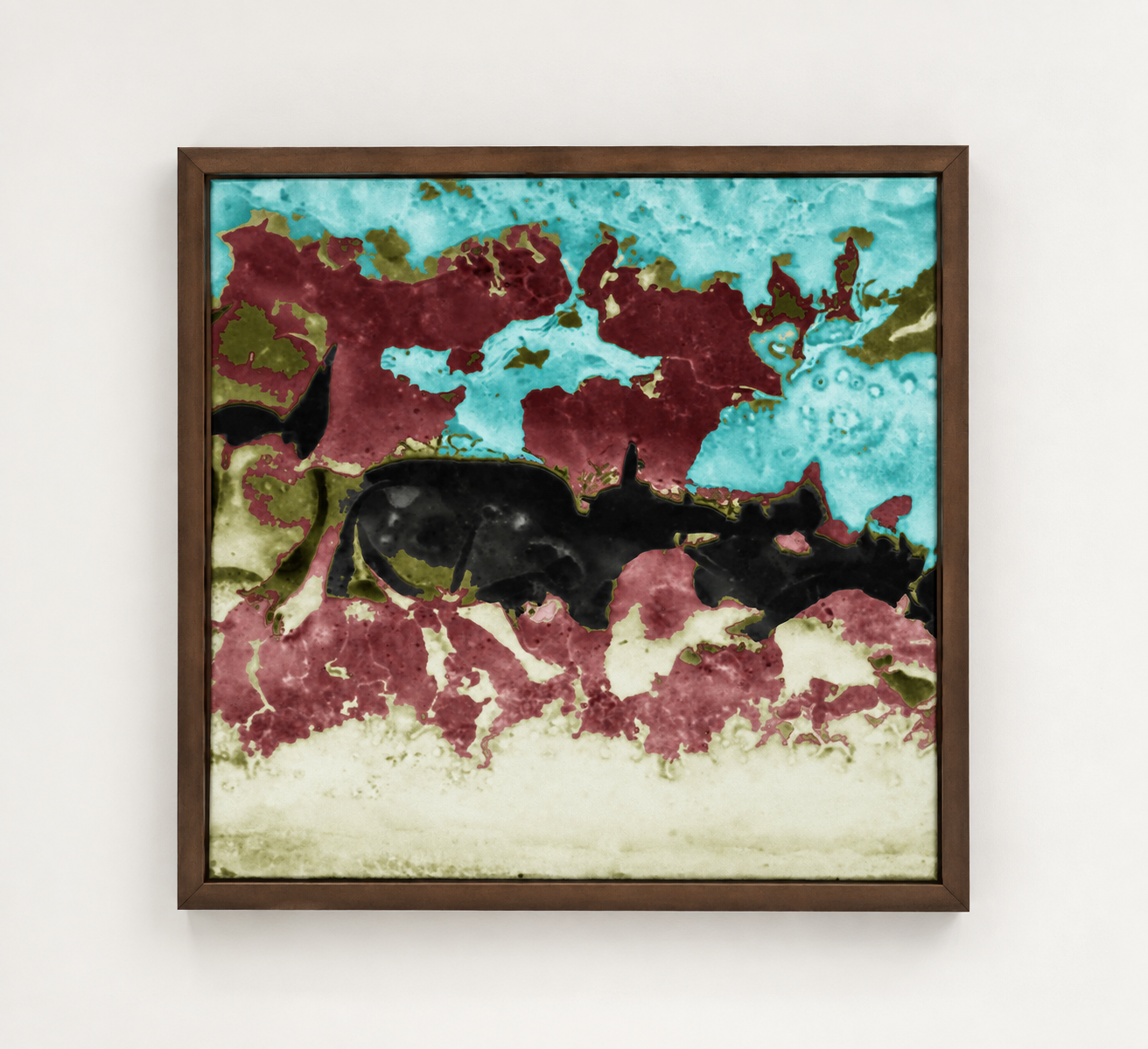
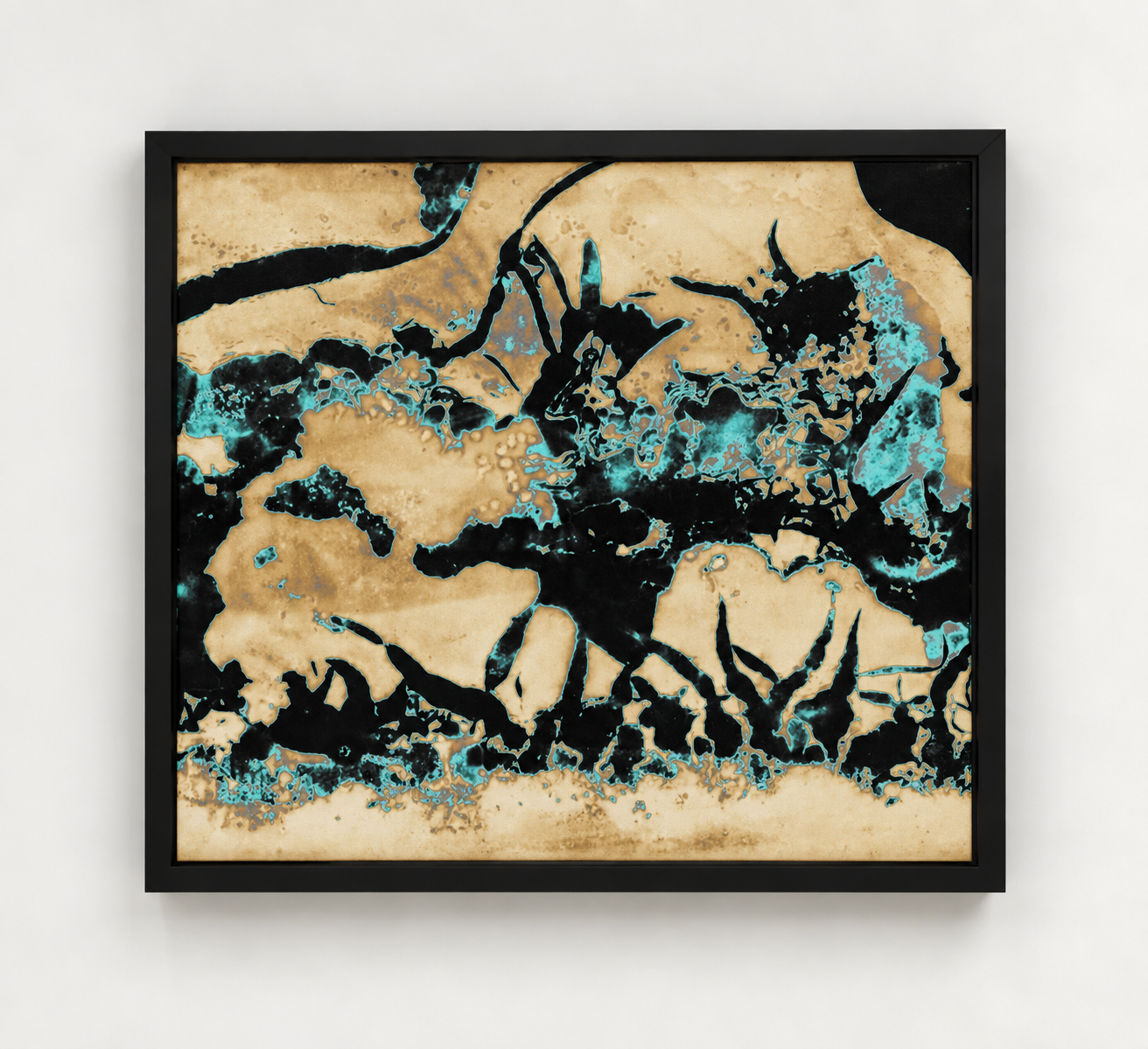
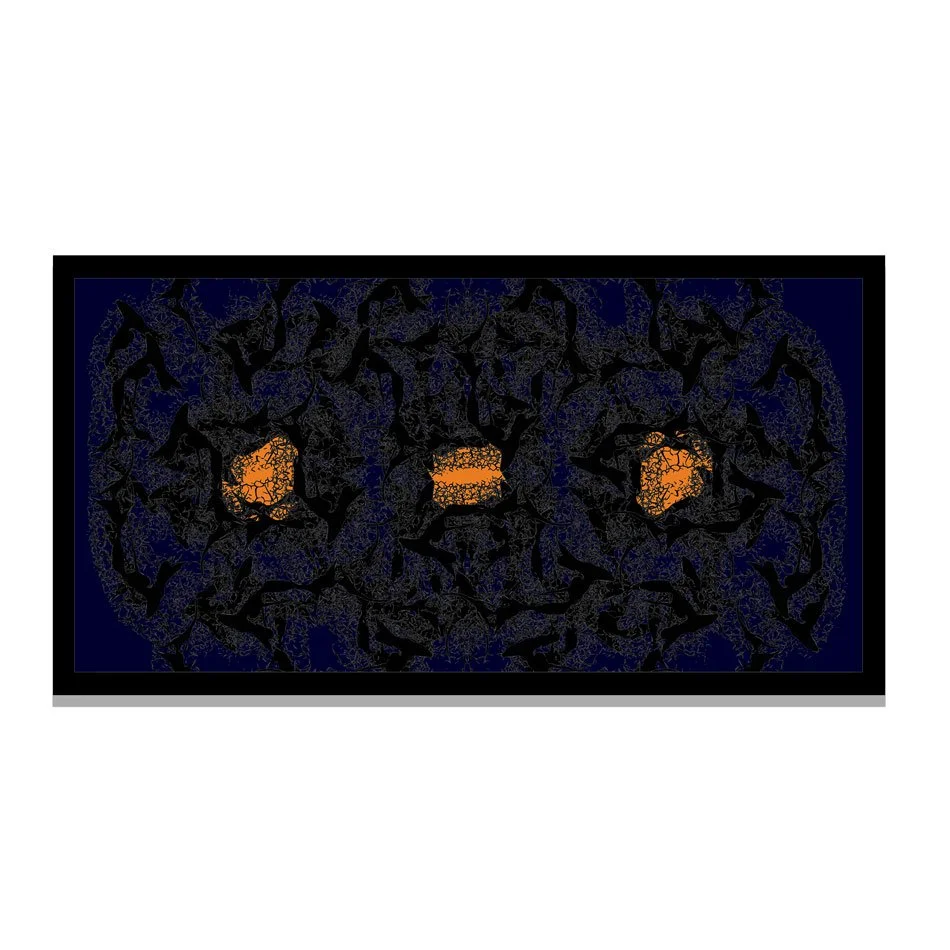
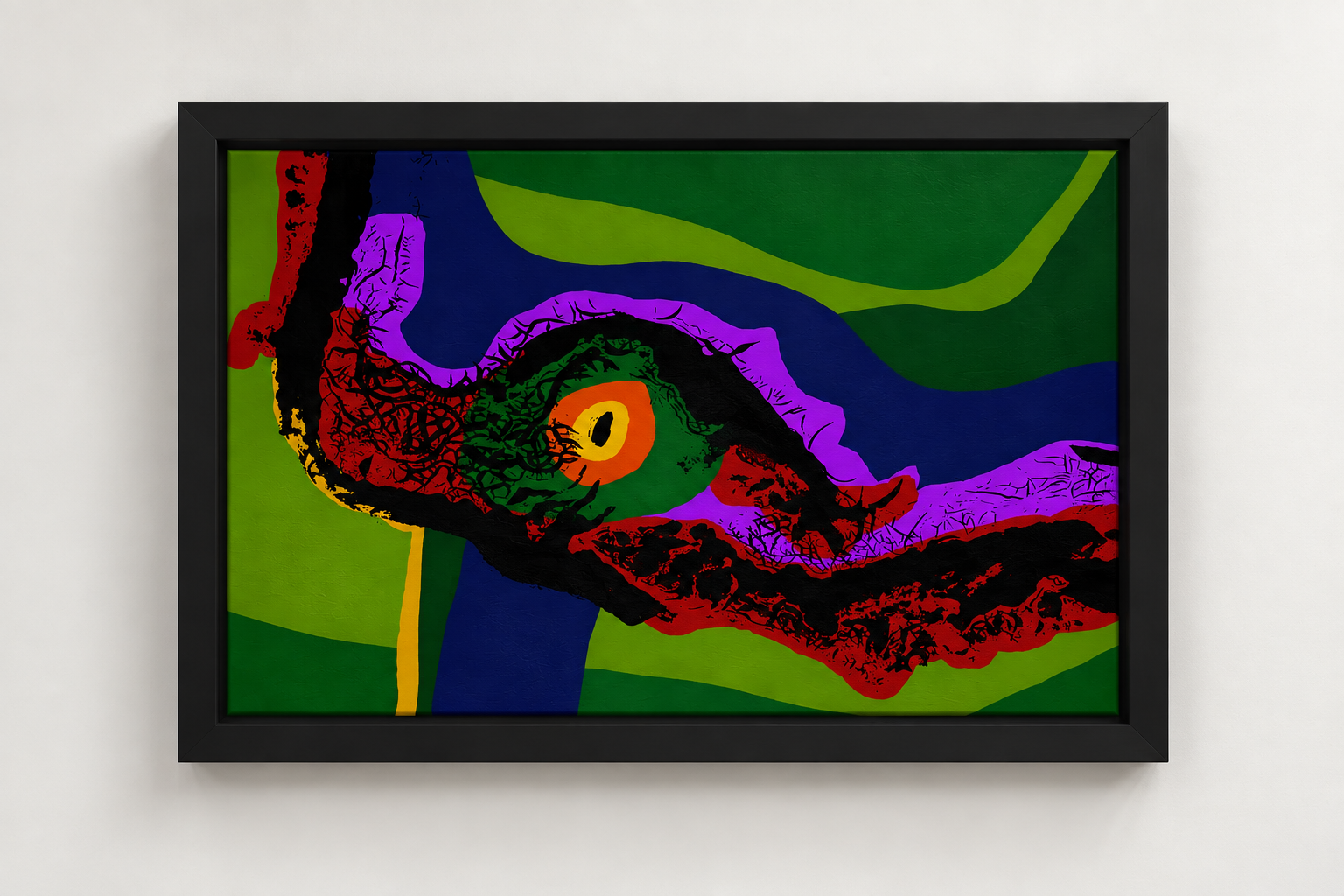
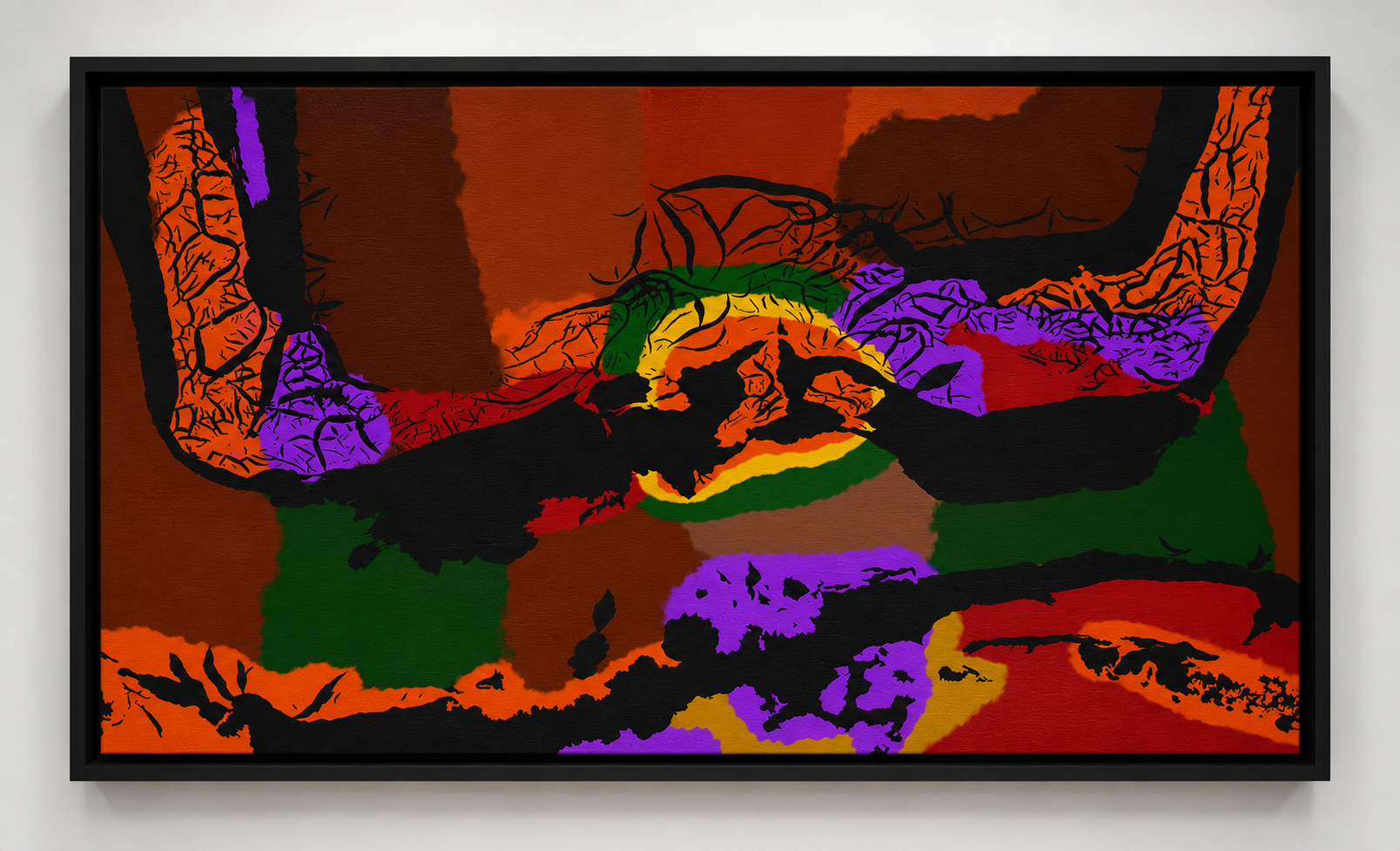
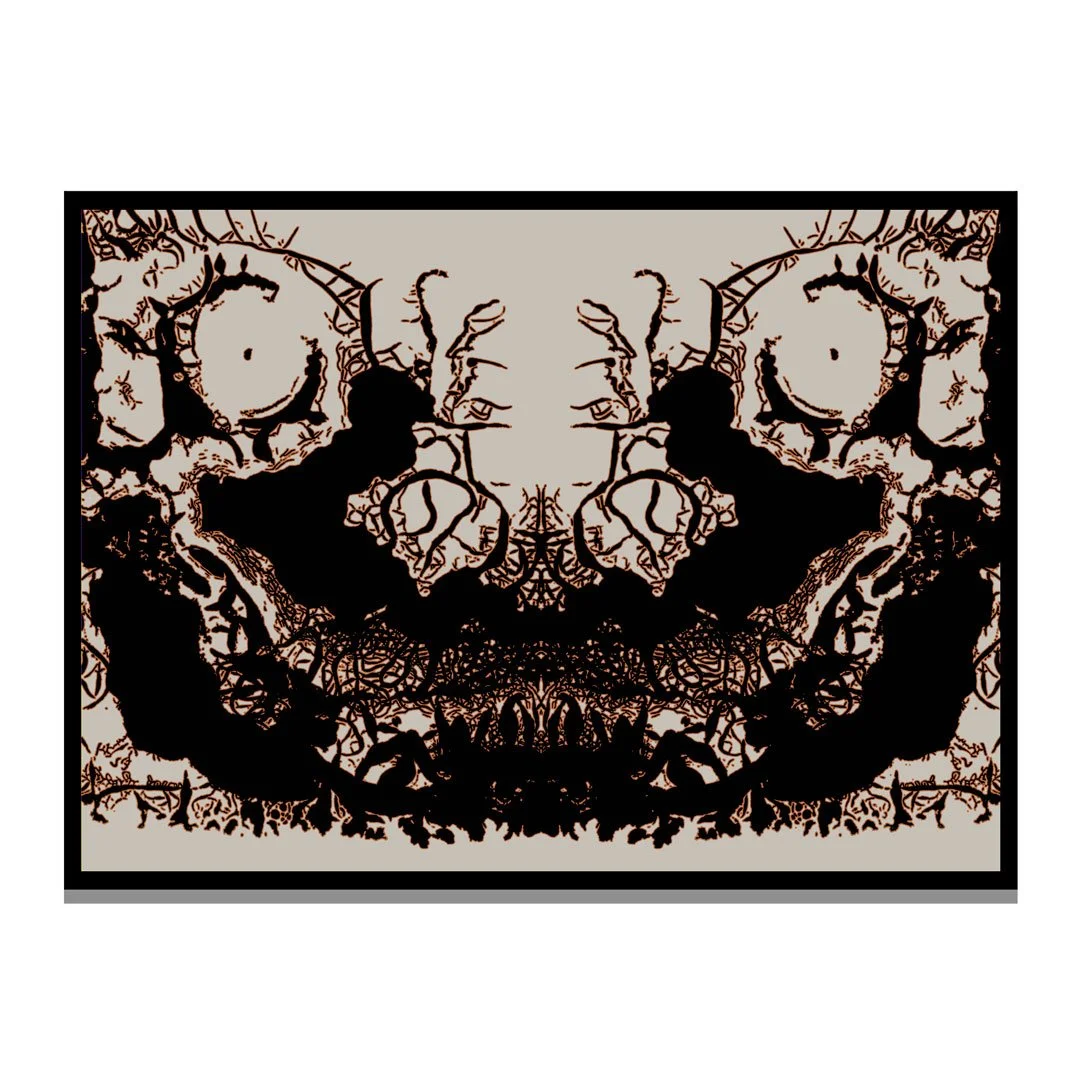
In 2026, I am expanding my practice further into the damaged traces left by deterioration. I am looking more closely at these marks, isolating and enlarging them, and using carefully selected crops to create new abstract compositions. Colour is also becoming more important, moving more freely through these forms and taking the work into new territory, while I continue to search for balance within each composition.
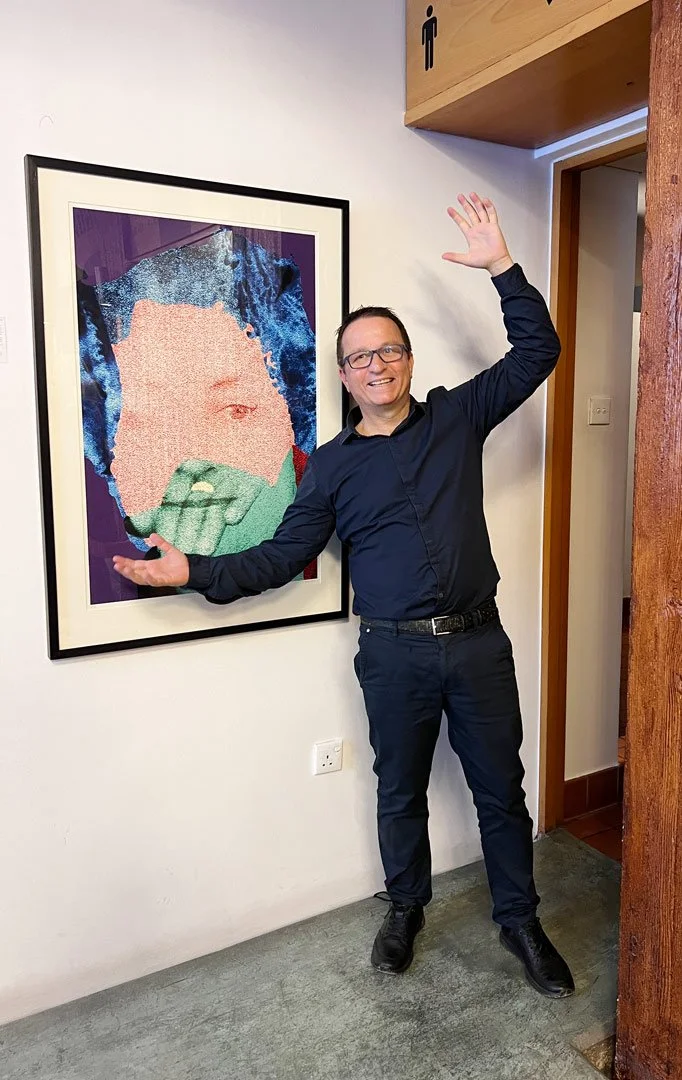
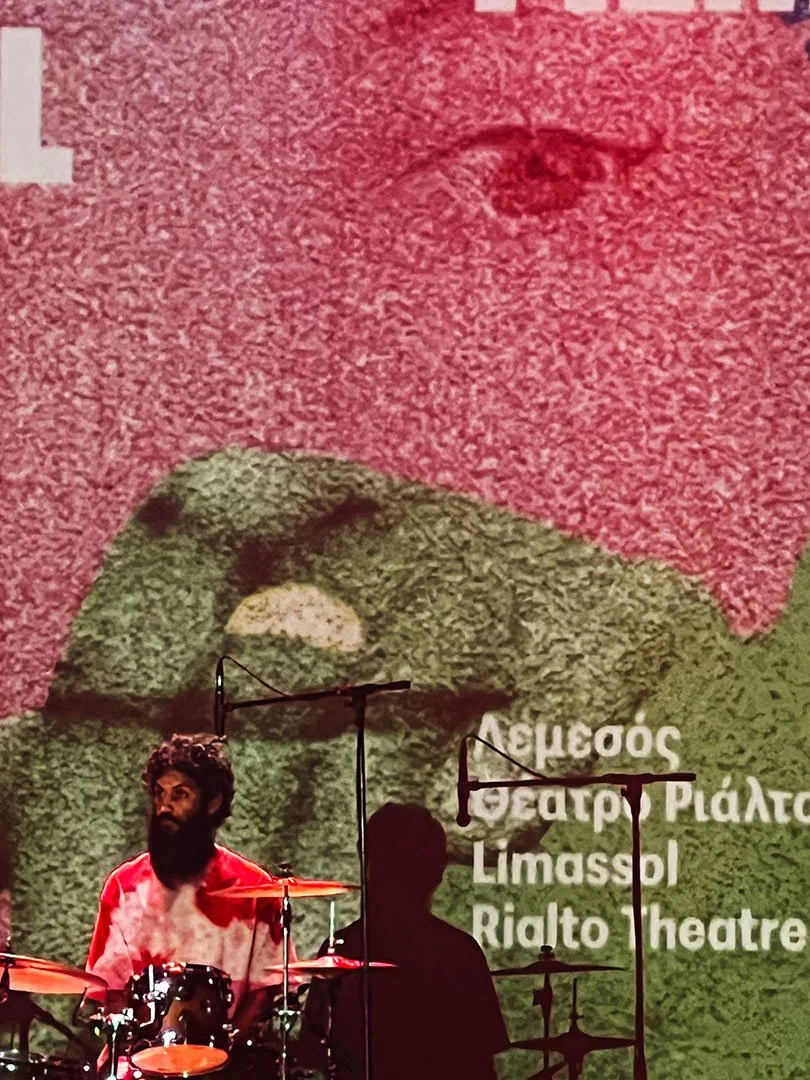
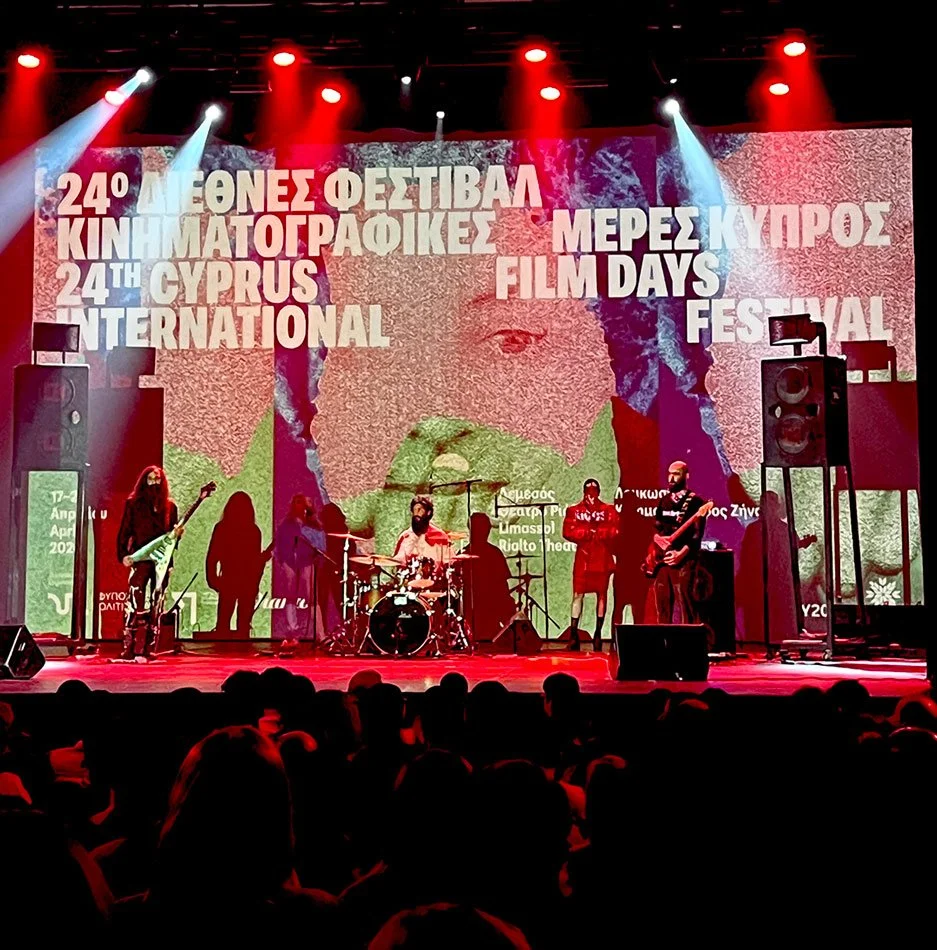
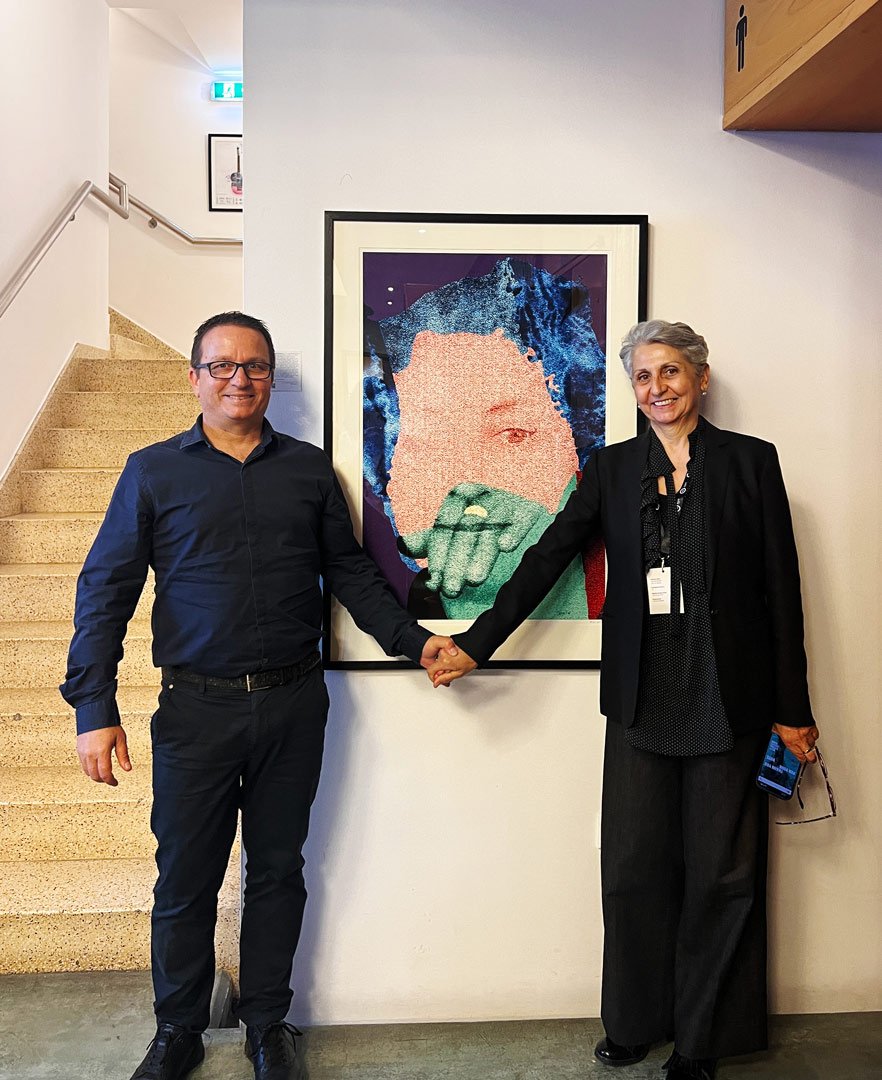
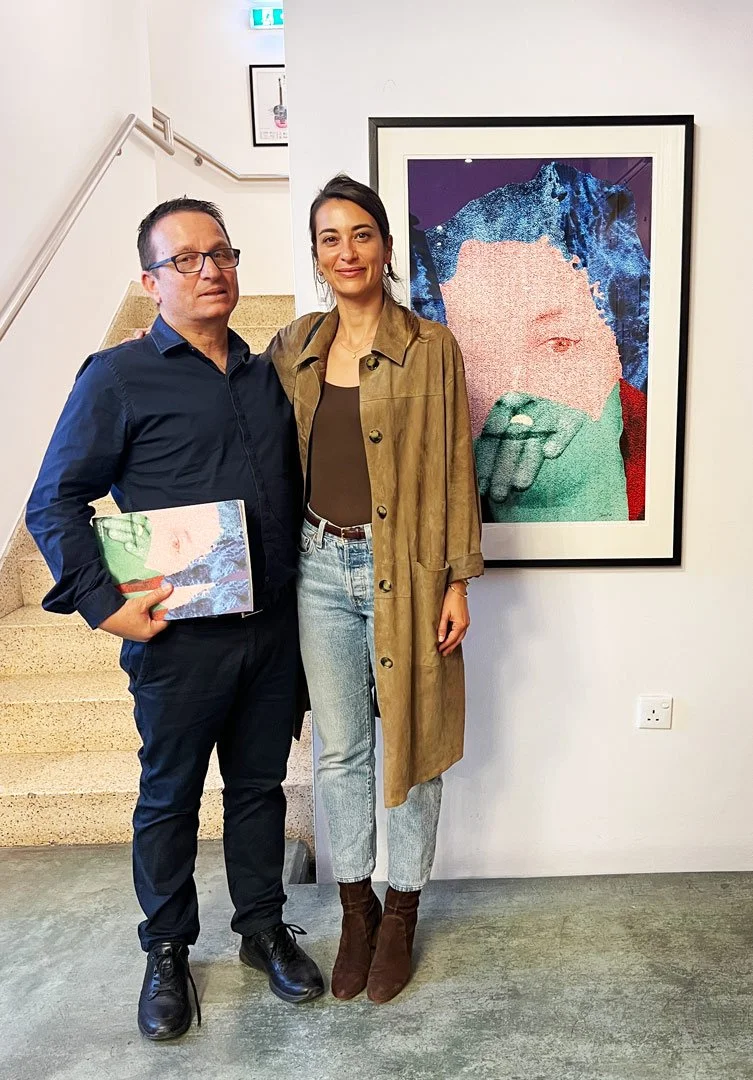
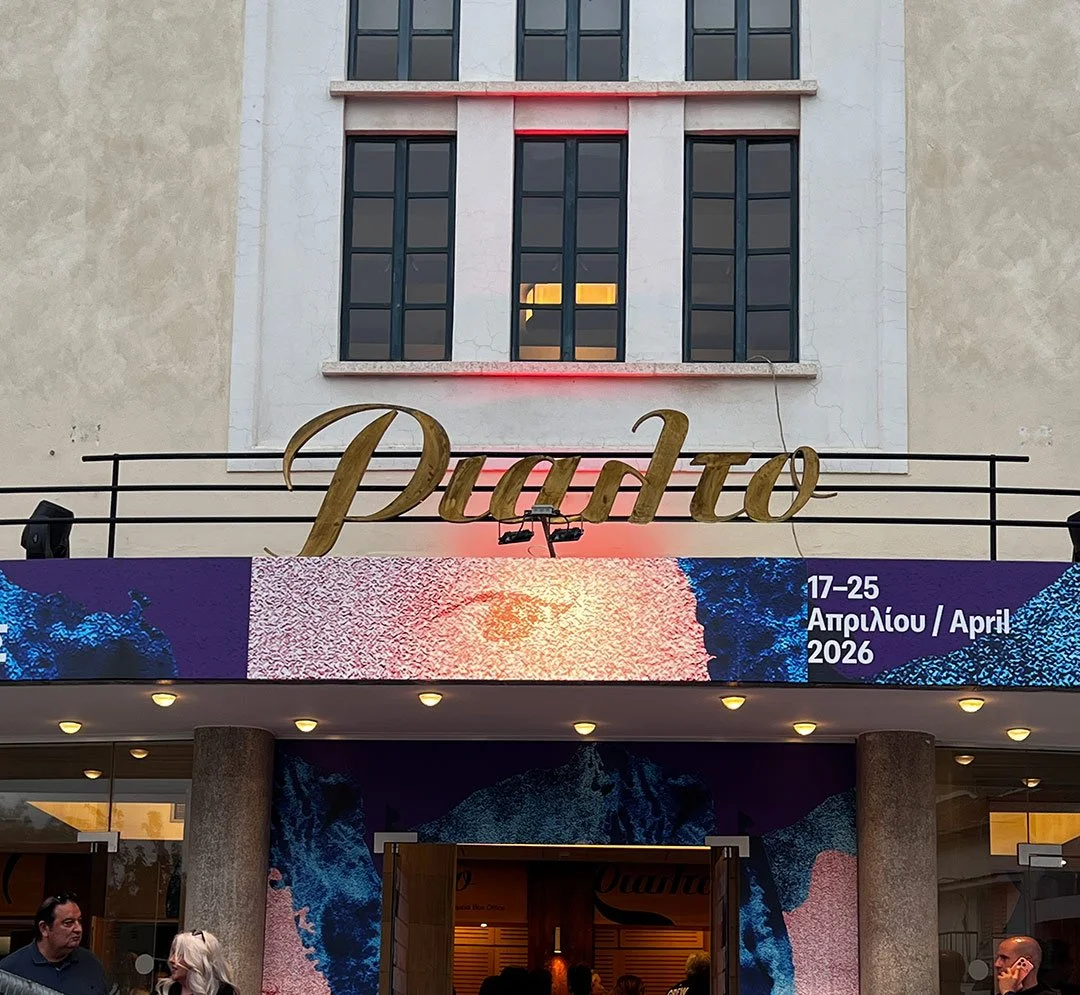
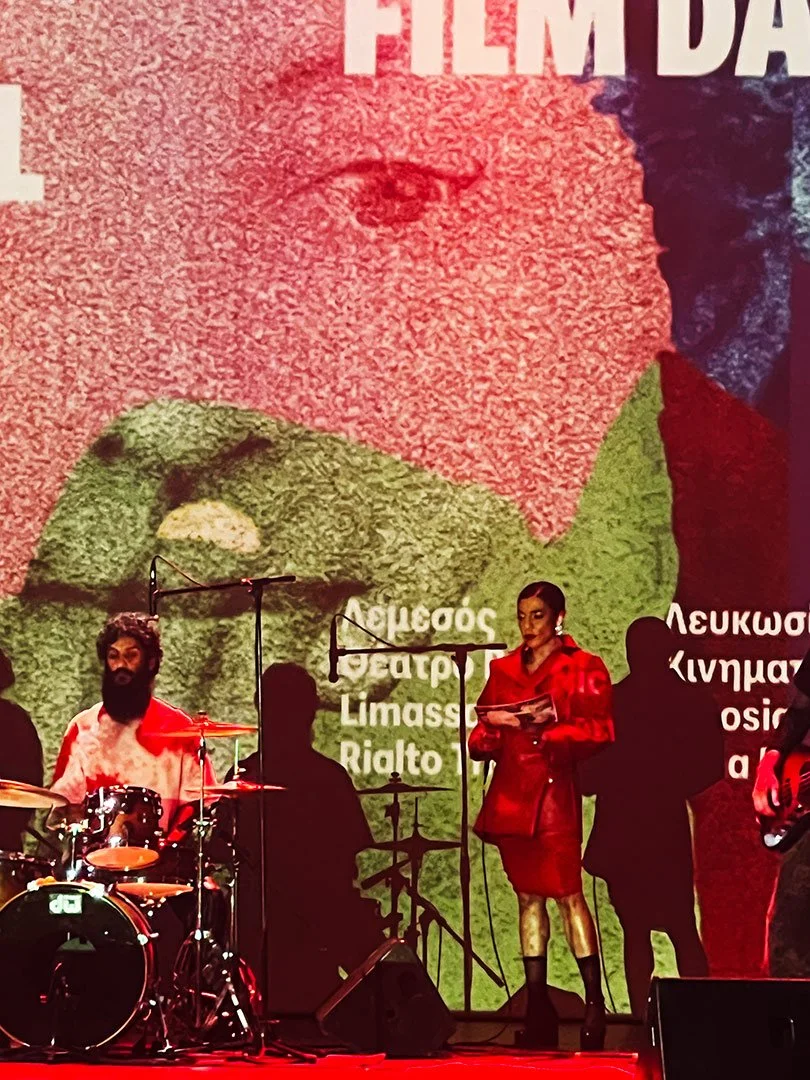
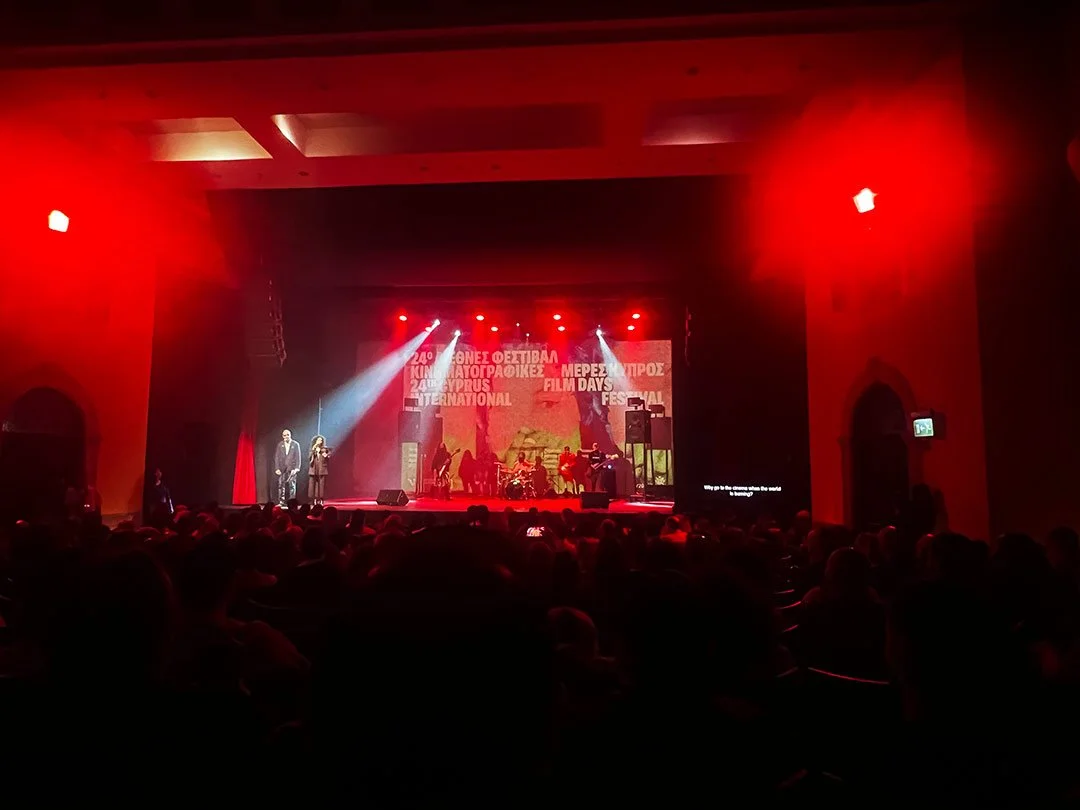
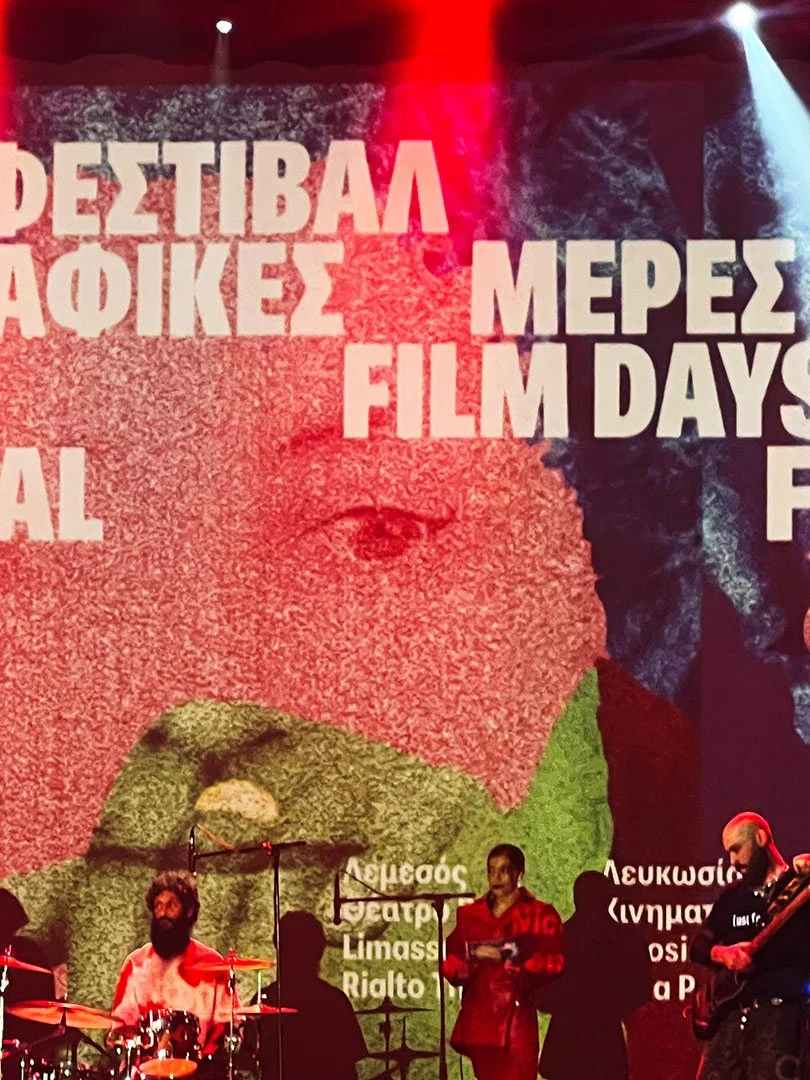
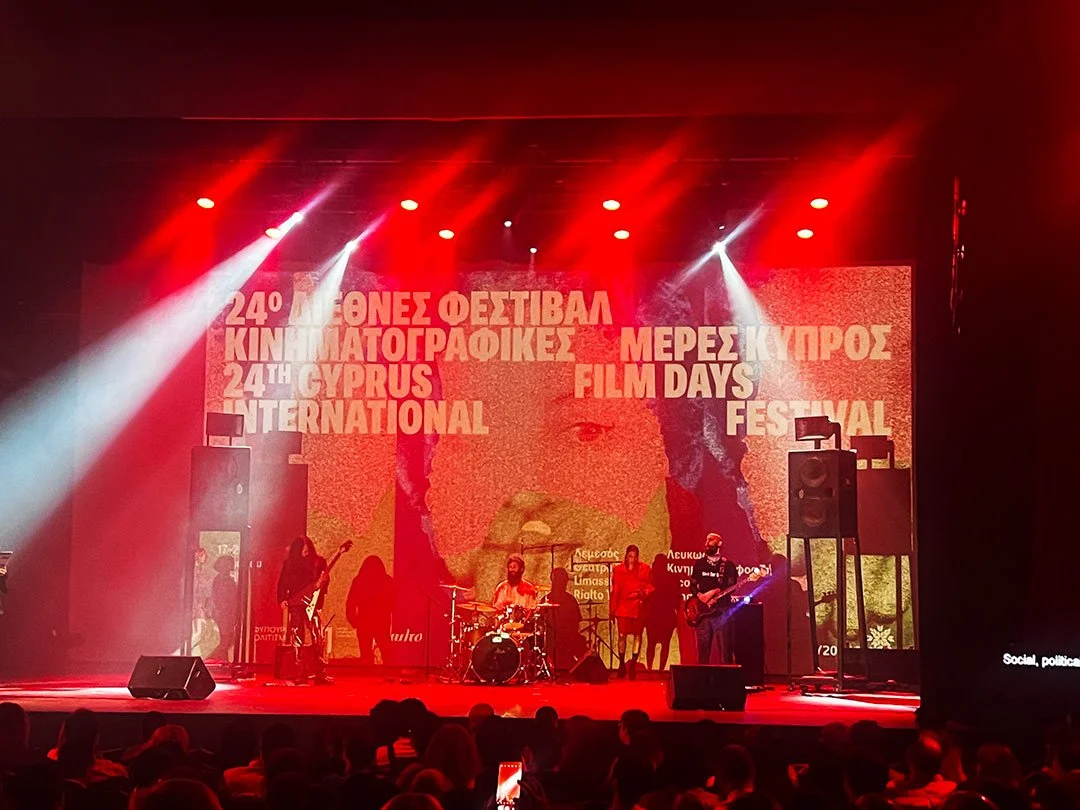
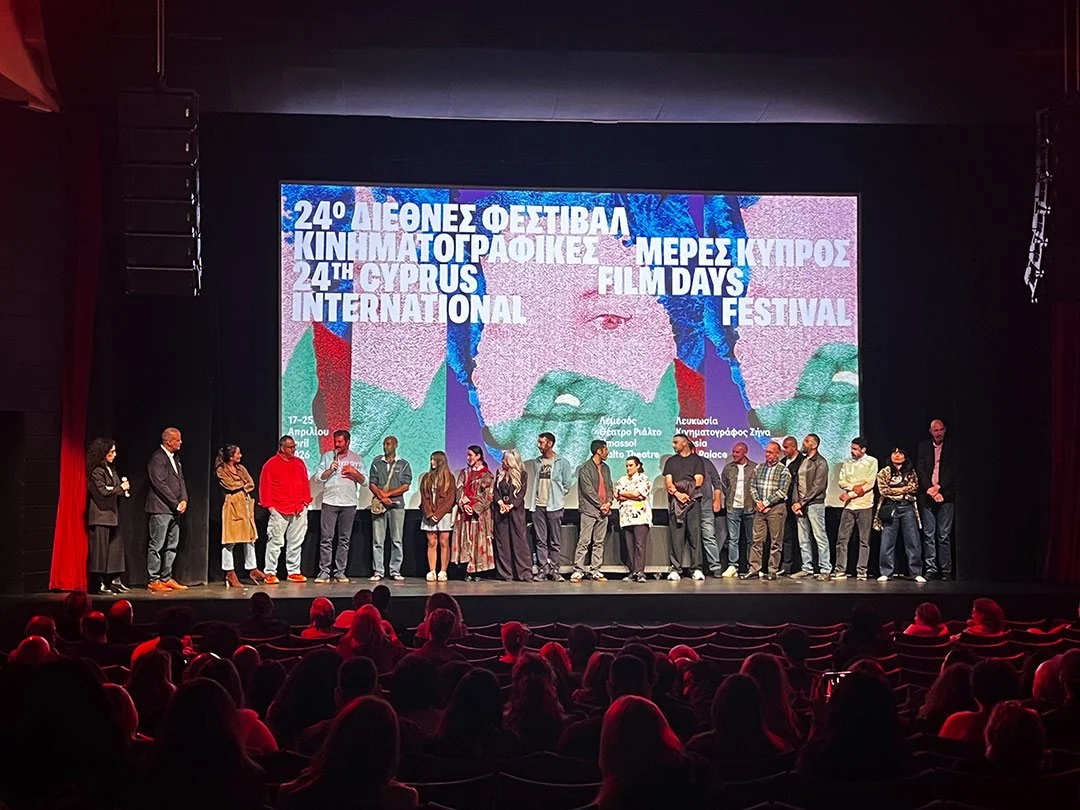
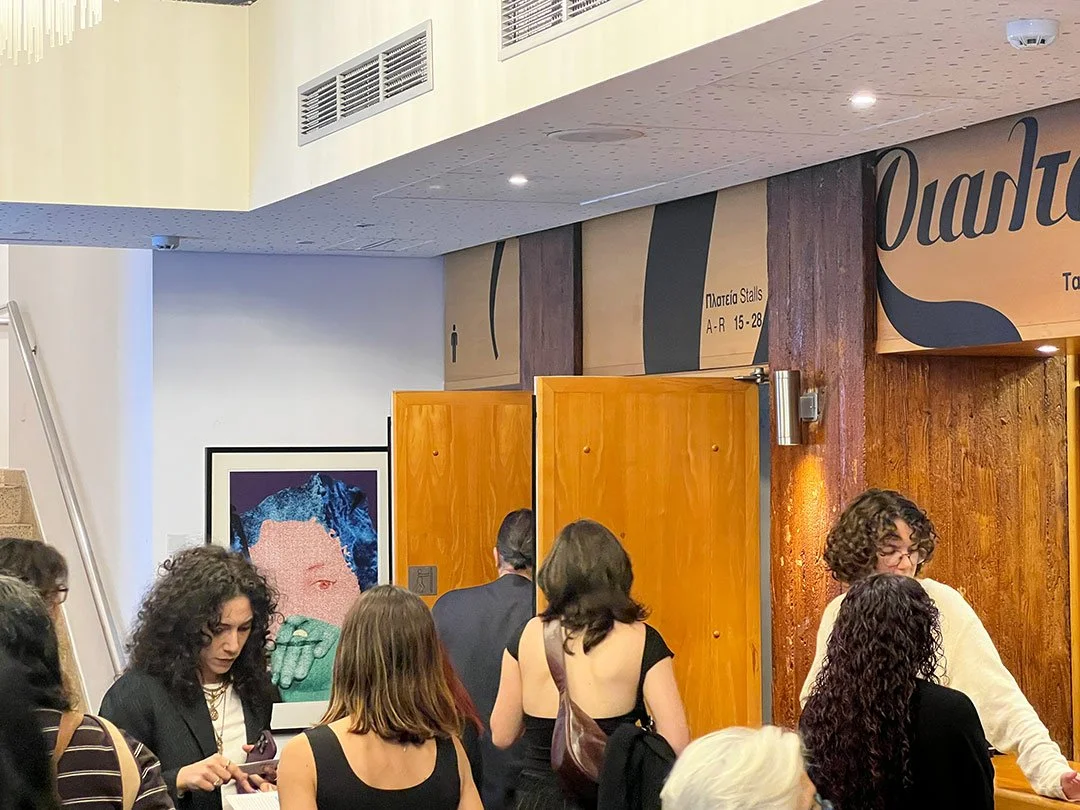
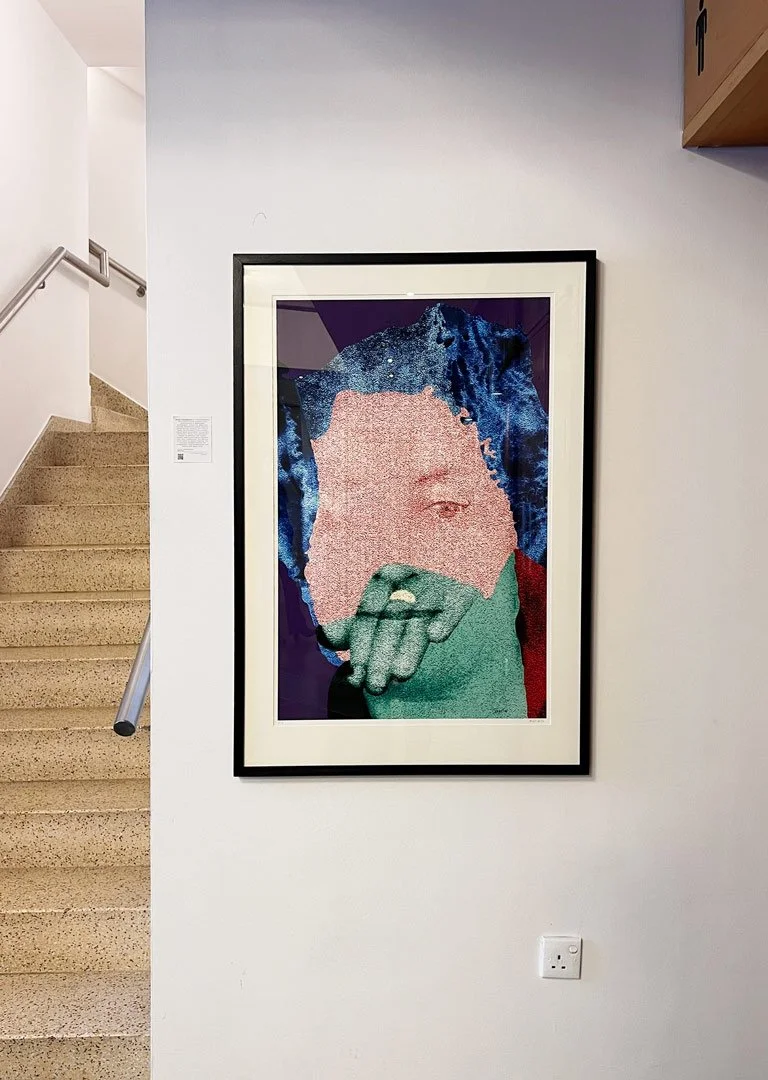
Elsewhere in my work this year, Elegant Gaze was selected for the poster and visual identity of the Cyprus International Film Festival at the Rialto Theatre in Limassol.
You can also read a text by Charalambos Charalambous reflecting on the development of my work and its evolution over the years.
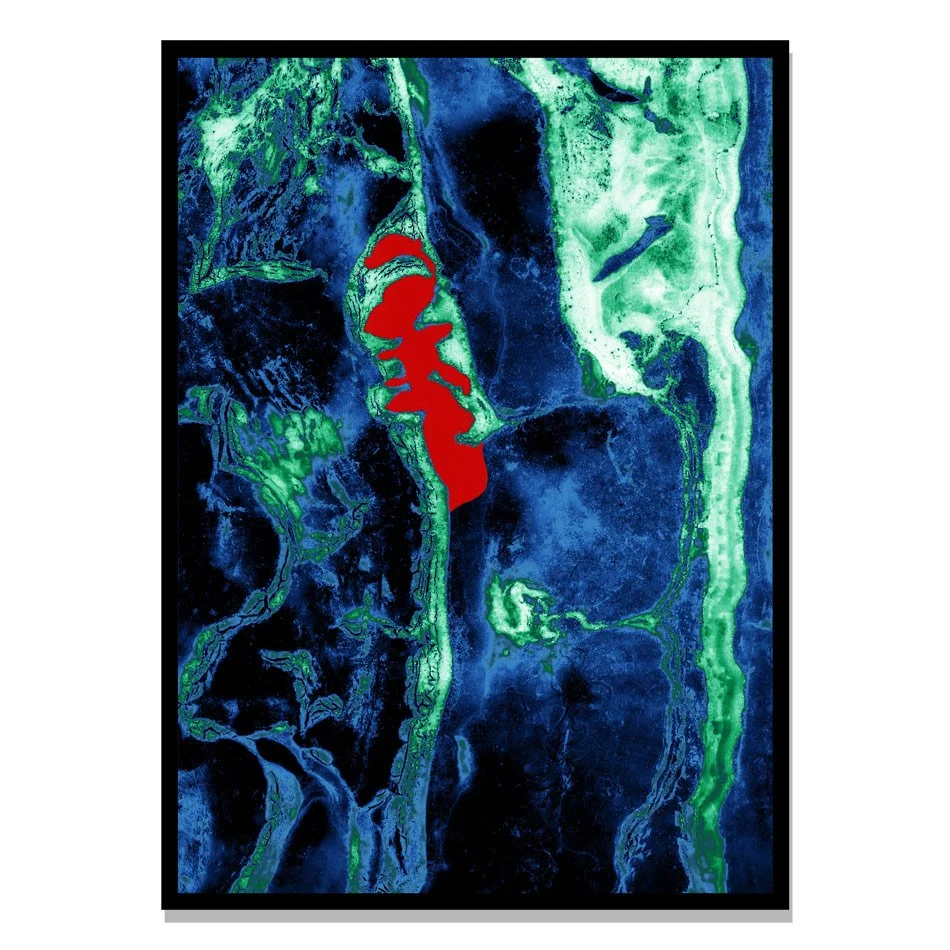
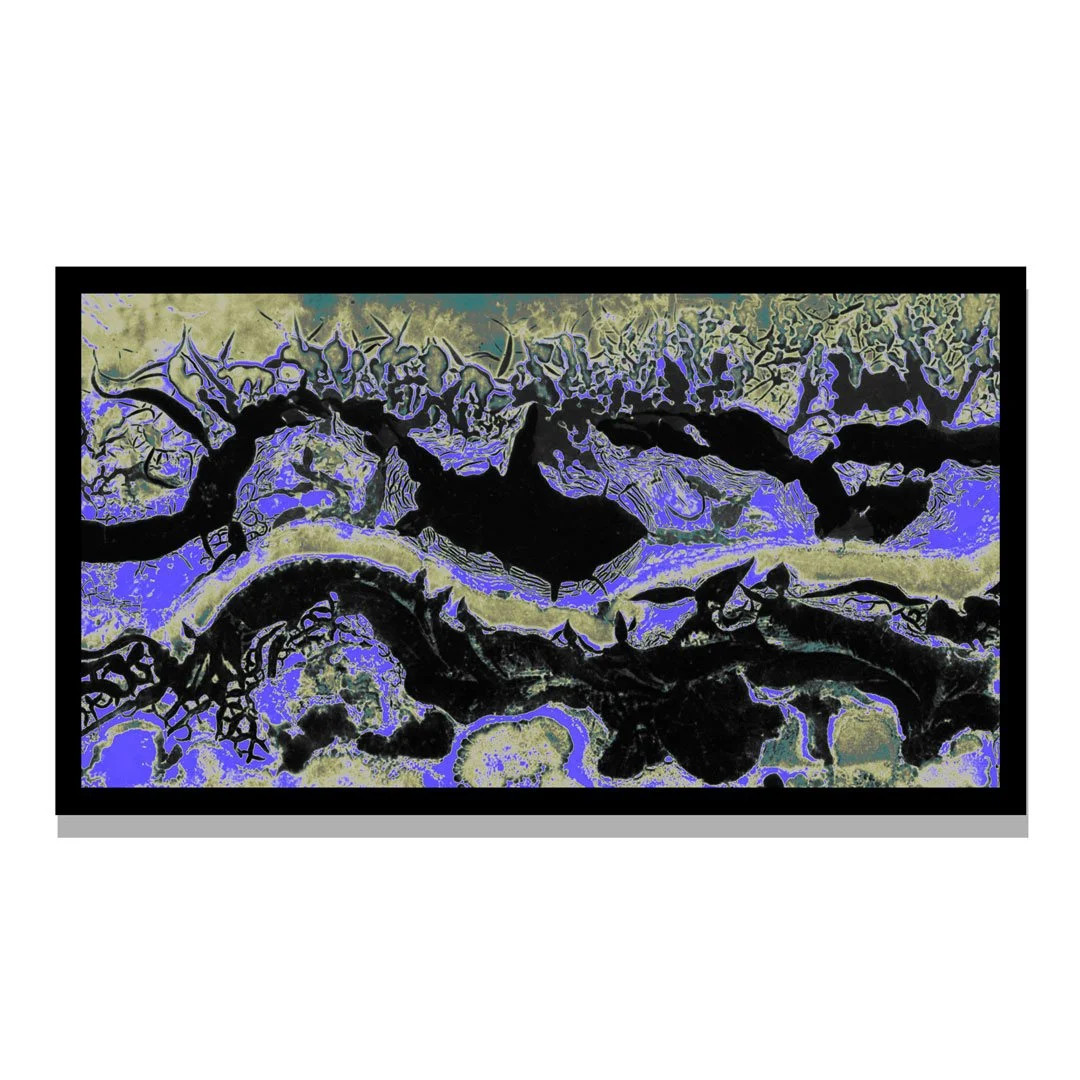
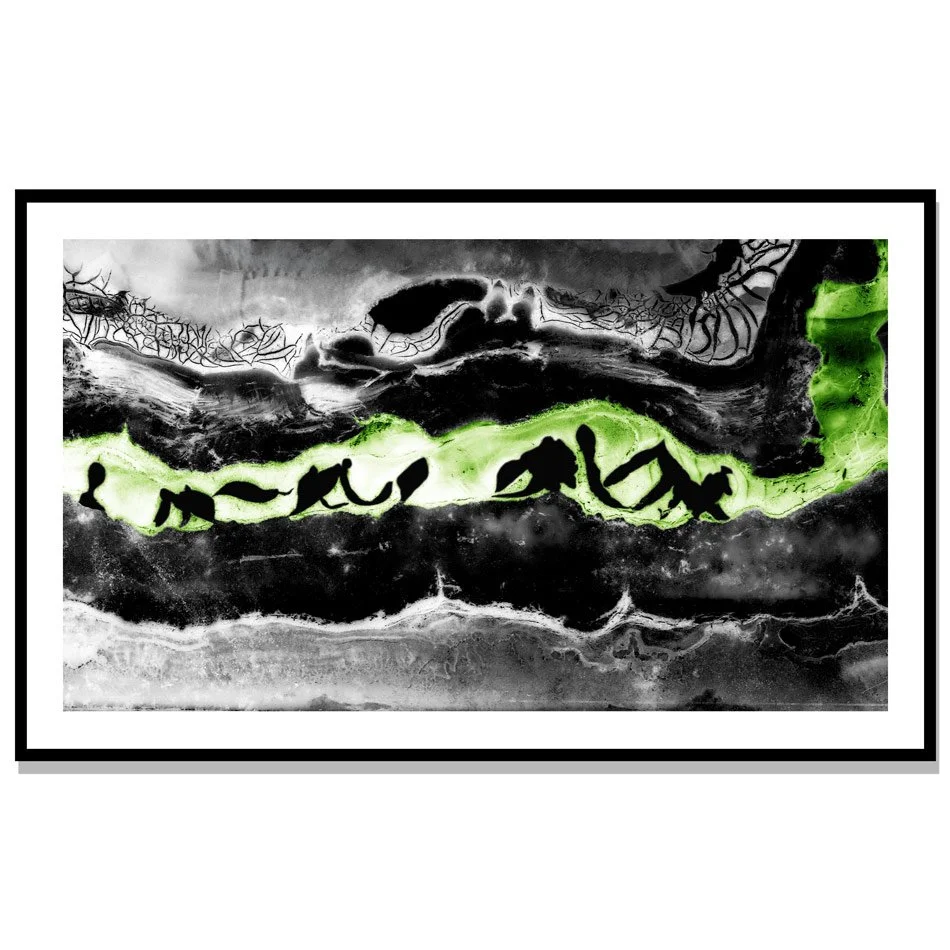
Affective Abstractions by Sergis Adamos presents abstract contemporary artworks drawn from deteriorated motifs extracted from early photographic glass negatives. Through digital manipulation, color, and material transformation, these works shift decay into atmosphere, feeling, and visual intensity, extending the archive into a new abstract language.
2026

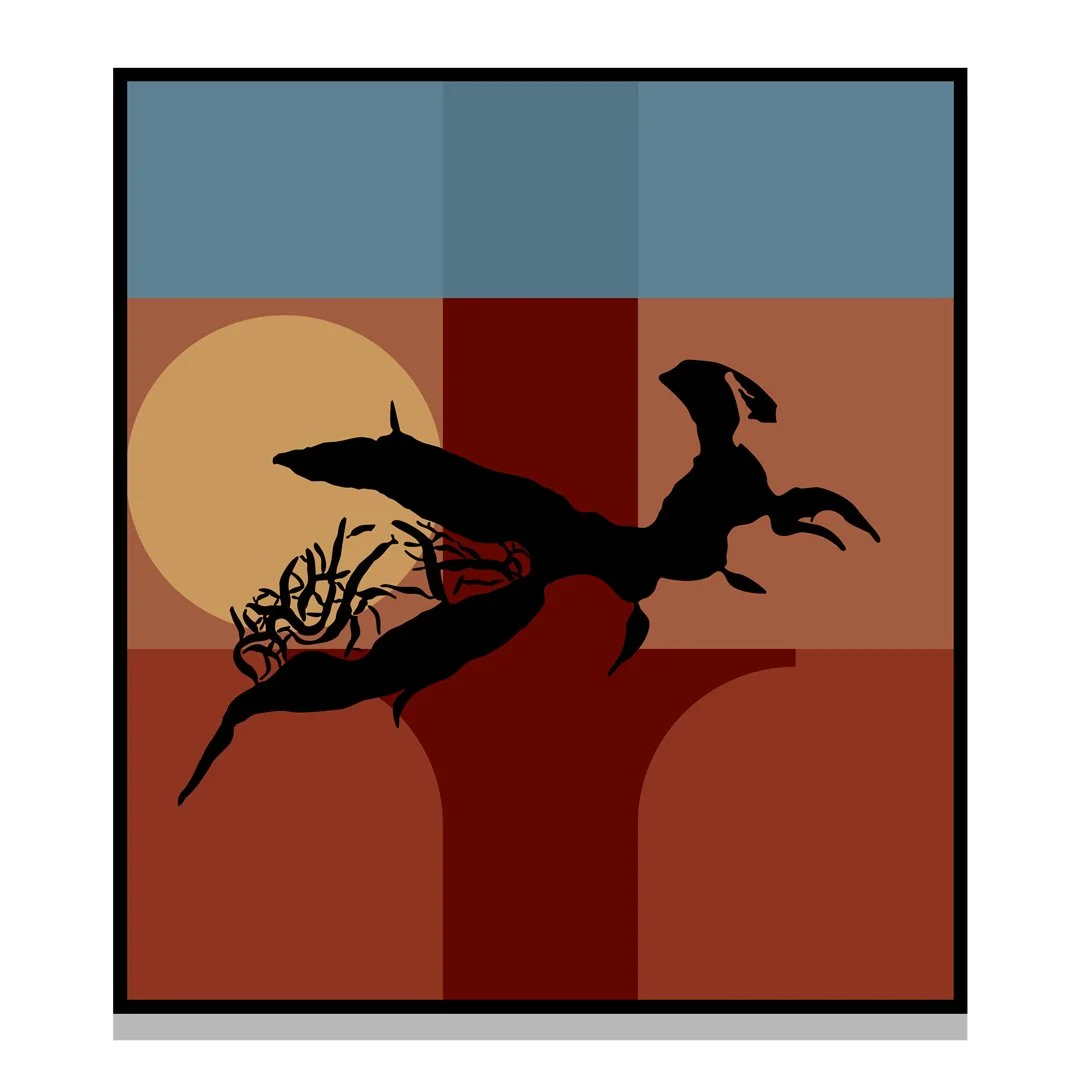
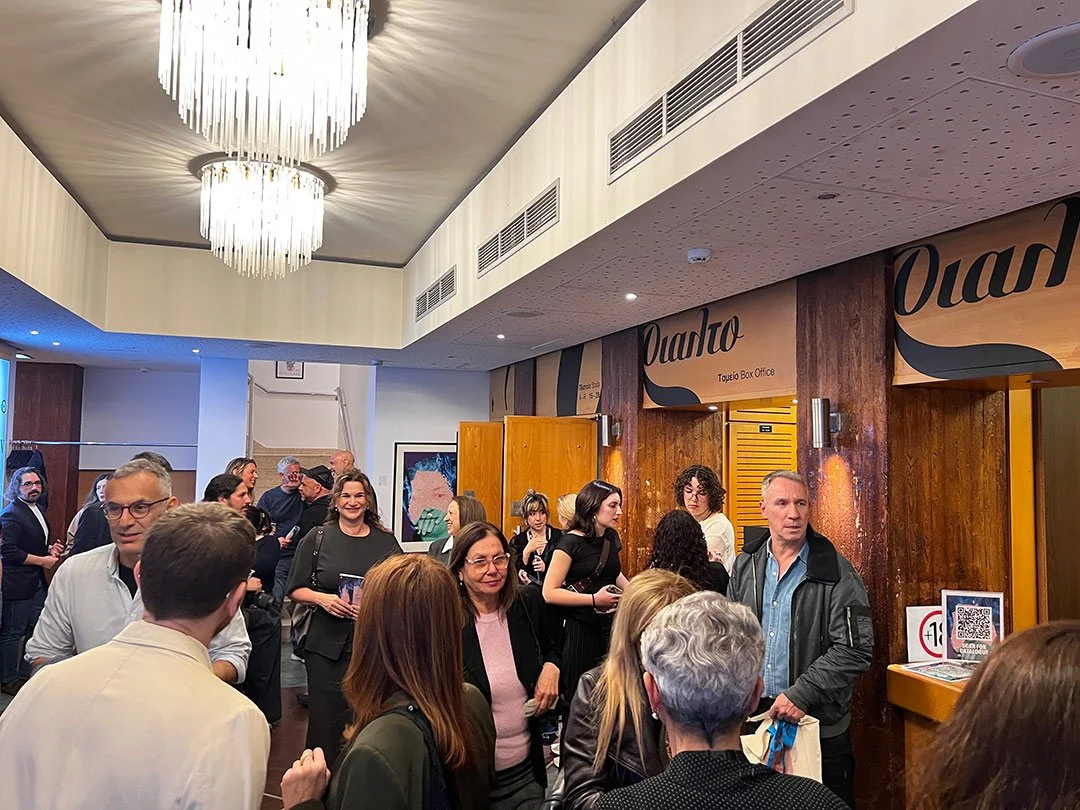
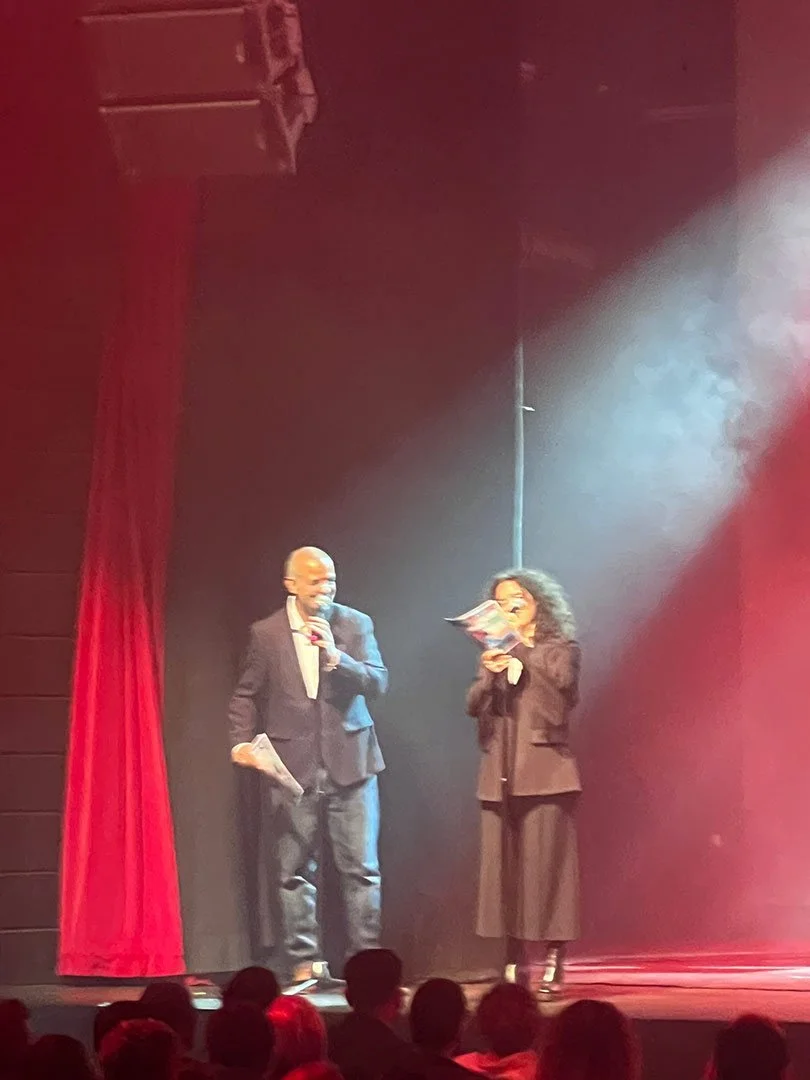
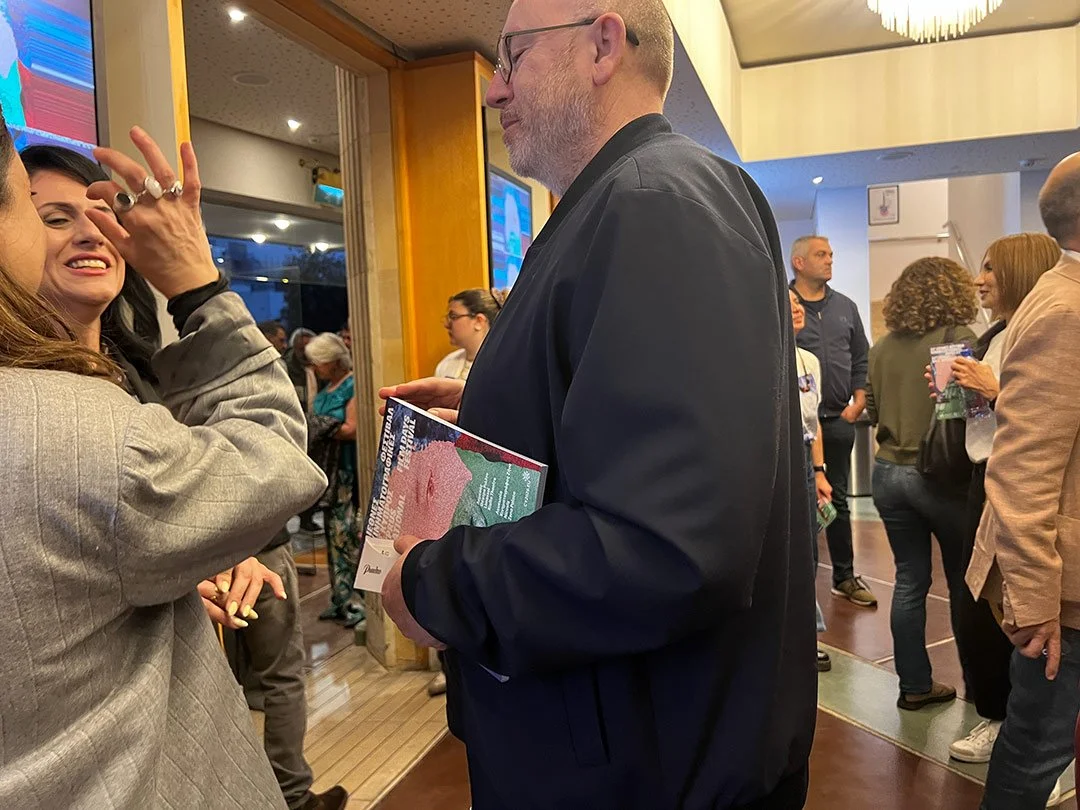
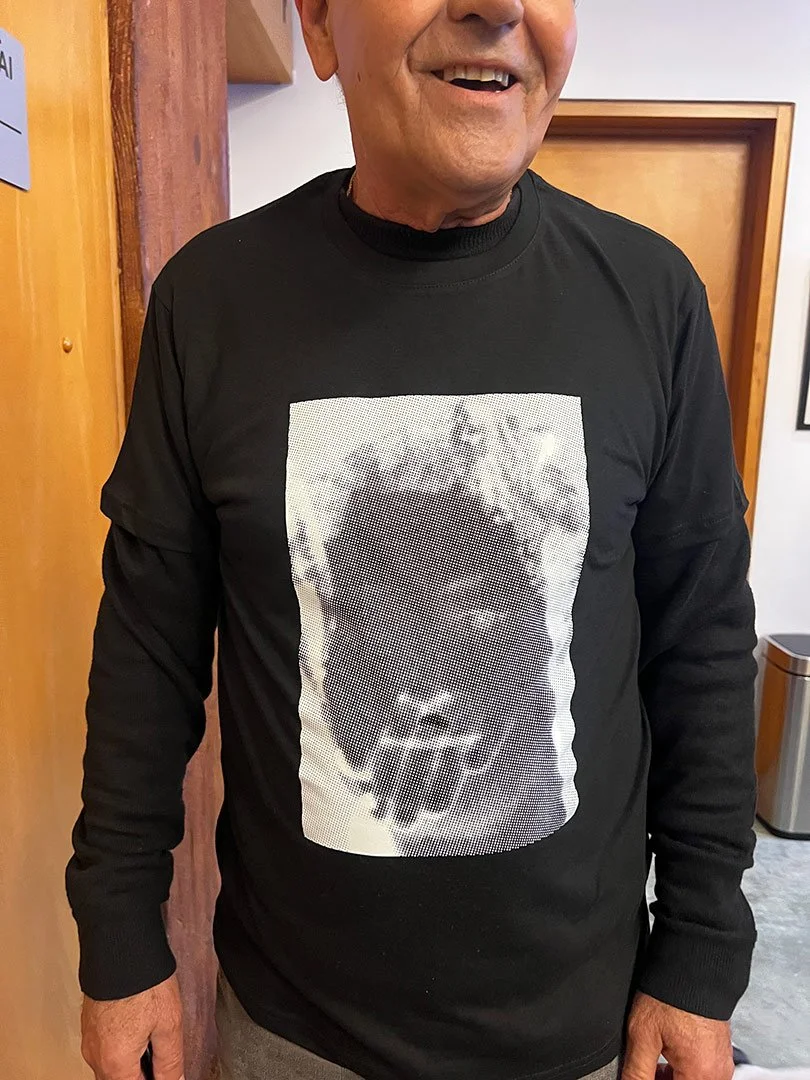
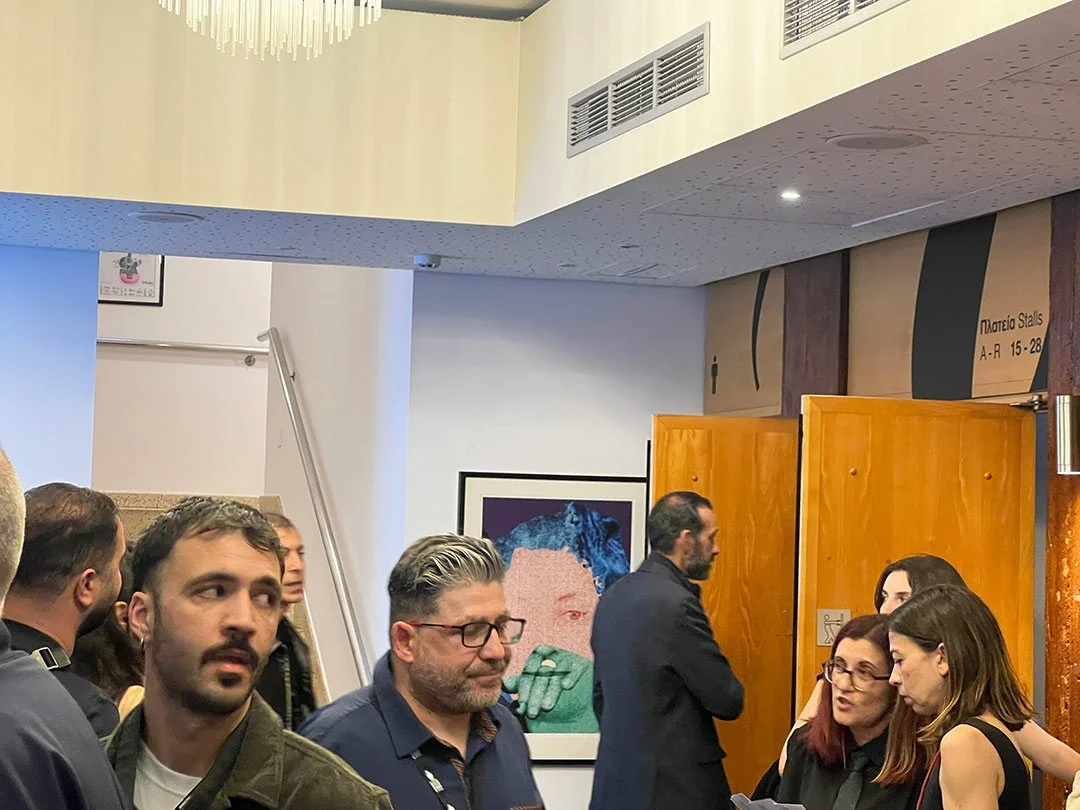
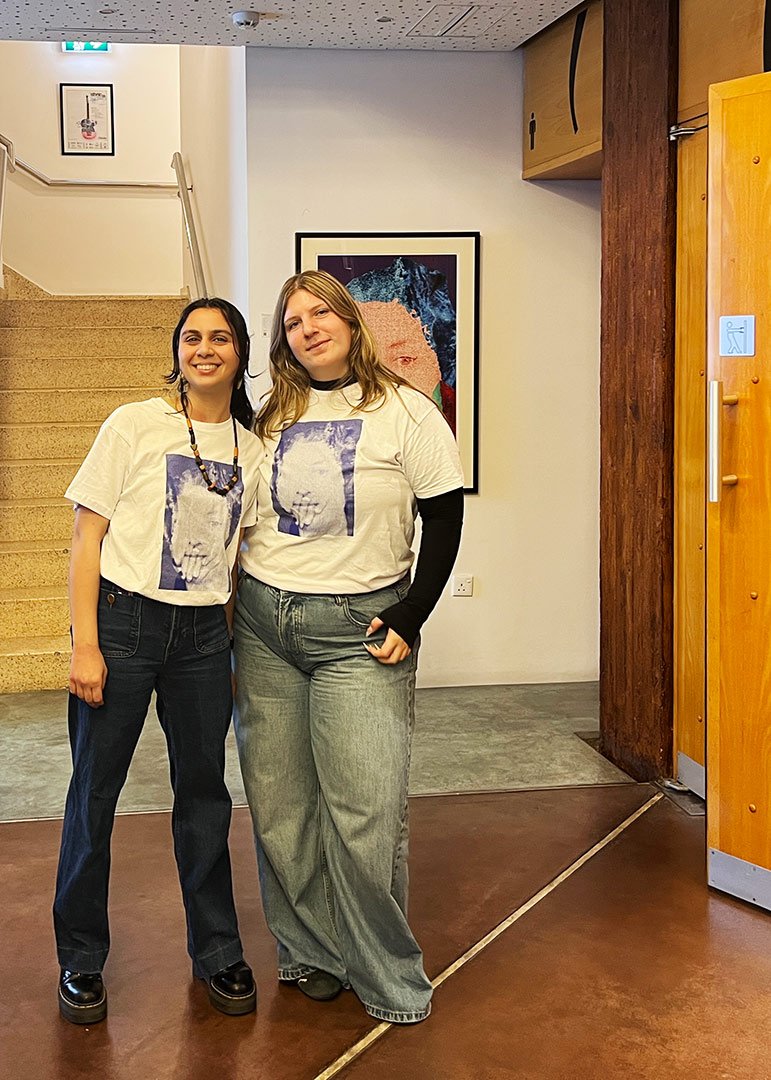
On the 17th of April, I had the pleasure of experiencing a special evening at the opening of the international film festival, Cyprus International Film Festival, which took place at the Rialto Theatre in Limassol. With deep emotion and pride, I saw my work Elegant Gaze, which was selected to represent the festival, being presented with exceptional professionalism at every screening point.
I warmly thank the organizing team for this honourable recognition of my work, and especially director Petros Charalambous for his nomination, as well as the iconic Georgia Doutsi, director of the festival, for its impeccable management.
By Dr Charalambos Charalambous
Sergis Hadjiadamos found himself, almost unexpectedly, the custodian of a multidimensionally significant archive: the photographic archive of Spyros Charitos, a photographer of the city of Paphos -its people and world- at a time when photography functioned as an authentic medium of documenting social life, culture, customs and the history of a community—from birth to death.
While the Paphian Sergis seeks an institution capable of properly preserving and presenting this valuable archive and its historical and social dimension, Sergis the artist has for years been confronting the archive in a parallel dimension—one that concerns its aesthetic qualities and images that time itself gradually dissolves from the glass photographic plates.
Emulsion Bloom
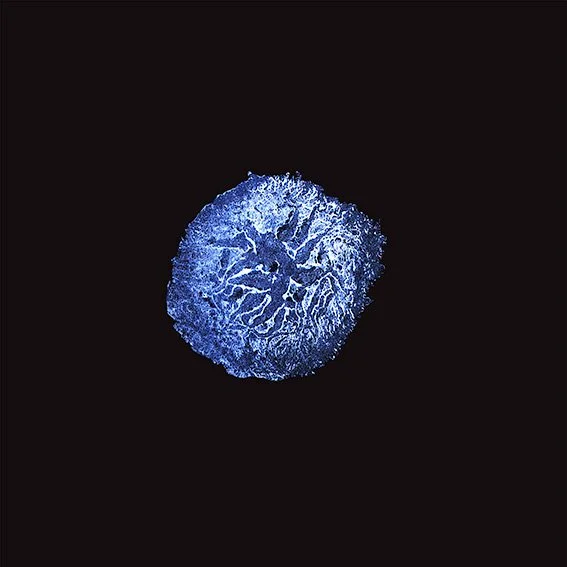
Introducing the exhibition is the strikingly contemporary Emulsion Bloom, a work that represents a failure, or rather the precise moment of mishappening. You can already see how fluid the transition is from representation itself, to the time of representation. A coloured dot —the artist intervenes through the use of colour, to highlight the phenomenon— marks the exact moment when the chemical emulsion that creates the photographic image fails. The emulsion detaches from the glass plate and begins to reveal its own distinctive aesthetic characteristics, which in later examples aggressively occupy entire images. Associations arise with cosmic formations, galaxies, or gravitational voids of space, confronting the viewer with scales of space and time that are difficult to grasp. These are generative moments despite their apparently destructive nature. Before Sergis reached this stage of accepting visual failure, he himself had to traverse great perceptual distances. Believe it!
-
I had the opportunity to witness the storage of this archive in preparation for its relocation from a damp and dark basement of the Charitos residence in Paphos. Unfortunately, part of it had been submerged in water after torrential rains. Yet, both that portion and the rest of the archive had already suffered successive attacks of decay caused by seasonal humidity, which, like a wood-boring parasite, gradually eats away at the edges of the photographic images and each year penetrates deeper toward the center, claiming an ever-greater portion of representation.
These photographic plates—now amalgams of space and time—Sergis attempted to expose to the penetrating light of a digital image scanner. It was then that images returned to life in a completely unexpected way. The accidental layering of multiple images created visual palimpsests with interconnections that exceed any original intention of representation. At the same time, they retain something deeper that binds them together and transcends their archival dimension and value.
Thus, one can understand the artist Sergis’s initial instinct to attack the very act of representation and the faces depicted within it. It is a clear statement that the intention is not to answer the questions of who or why. The priority now is to guide viewers of the emerging images toward understanding their true creator: time.
Time, which through decay not only gradually erases the people portrayed but also imposes its own characteristics—visually chaotic formations resembling the temporal rings of a woody organism, capable of revealing cosmic explosions, measure millennia and record floods and ice ages.
Thus Sergis discovered that while he initially believed he was merely competing with historical figures and their representation during the artistic transformation of the archive, he was ultimately competing and struggling with time itself and with its attributes: decay, absence, oblivion, and chaos.
Even if you believe the outcome of this “battle” to be predetermined, I would ask you to recall another confrontation: that of the Knight and Death playing chess in Ingmar Bergman’s cinematic masterpiece The Seventh Seal. At the moment we believe the battle is lost, the Knight confesses that a move he has made—one that has gone unnoticed—will grant him victory. What is it that gives him the great motivation to defeat Death itself? Naturally, love. But alas, his confessor is Death himself, who coldly responds: “Did you really expect me to play by fair rules?”
Sergis, audaciously born on February 14, carries within him an unextinguished love for art and an inexhaustible affection for the archive. For years, this has been the driving creative force behind the imaginative ways he explores its visual characteristics. From the “erasure” of faces, he moved toward gentler techniques of alteration or intervention in their features—highlighting elements, isolating fragments, embracing decay, and even fully accepting the incomplete.
We arrive at the present day, years after the archive first emerged, where Sergis proposes through his exhibition “Whatever Remains, Make Art” something complete and fully developed.
Before even attempting to speak about the works themselves, I feel it is worth mentioning that each of Sergis’s exhibitions increasingly resembles a social celebration. An open invitation, a wide horizon of attendees, elevated spirits, music, abundant quality wine, and food.
It reminds me of earlier times—especially in Athens—when after visiting an art exhibition you would depart nourished by conversation, encounters, and good spirits. The mere opportunity to gather in the name of art was sufficient reason for the host artist.
It is not simply that Sergis understands this. It is not only that he is now ready to celebrate the archive. Nor is it merely that such an approach suits his temperament.
It is that art has become his entire world—and he invites you to become part of it.
After visiting Sergis’s exhibition, I felt the need to write about what I saw and felt. No one asked me to do so. And for me personally, this is important; because it indicates that I encountered something I could not simply overlook without expressing myself. The works are numerous and a result of long-term engagement, tracing the entire journey described above—the confrontation of the artist with representation and with the time that inhabits it.
Mesmerised Beauty
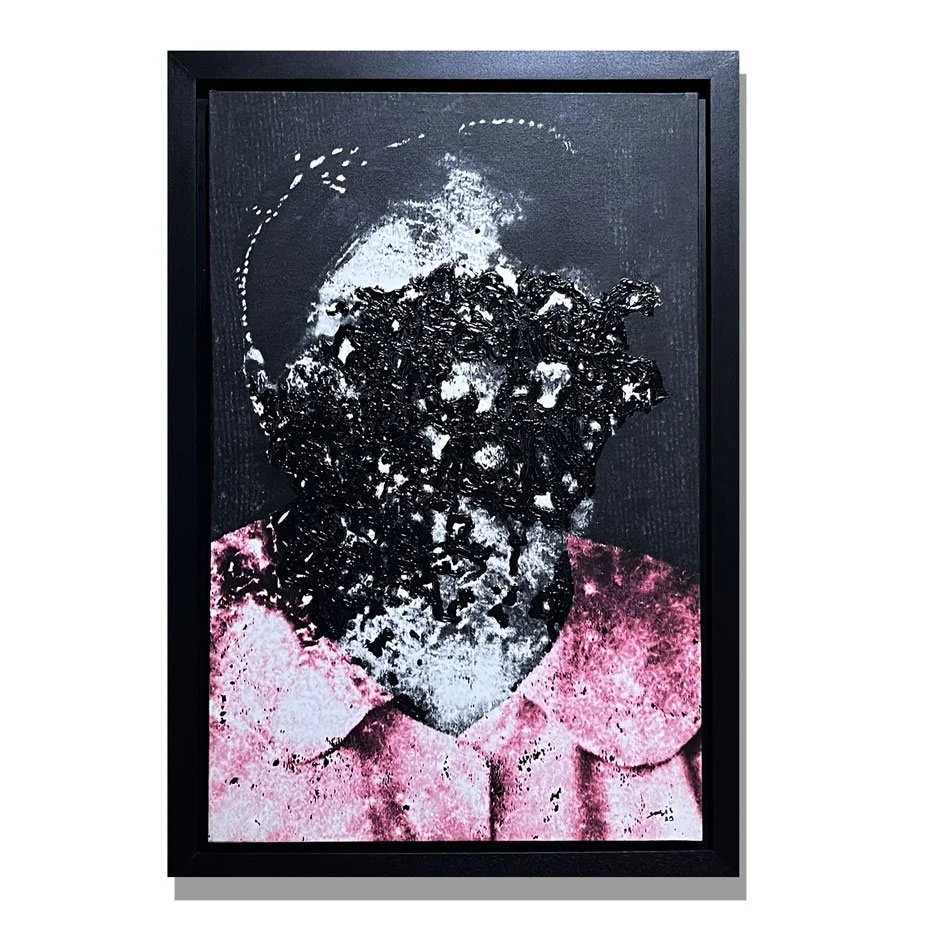
A characteristic expression of the attempt to cancel visual identity is Mesmerised Beauty, where Sergis intervenes directly upon the printed image using the traditional tools of the painter —the brush and paint— to erase identifying features. For anyone familiar with Sergis’s earlier attempts at erasure, it is now evident that the qualities of this action have undergone a process of refinement that has tamed them, giving them characteristics that imitate the natural erasure caused by time in photographs. The choice of monochrome, the intense texture, and the complex —almost organic— brushwork demonstrate that the exploration of erasure, penetrates far deeper than simply concealing an image or canceling representation. Something paradoxical occurs: an act of subtraction ultimately produces additive meaning for the work itself.
Liminal Bloom
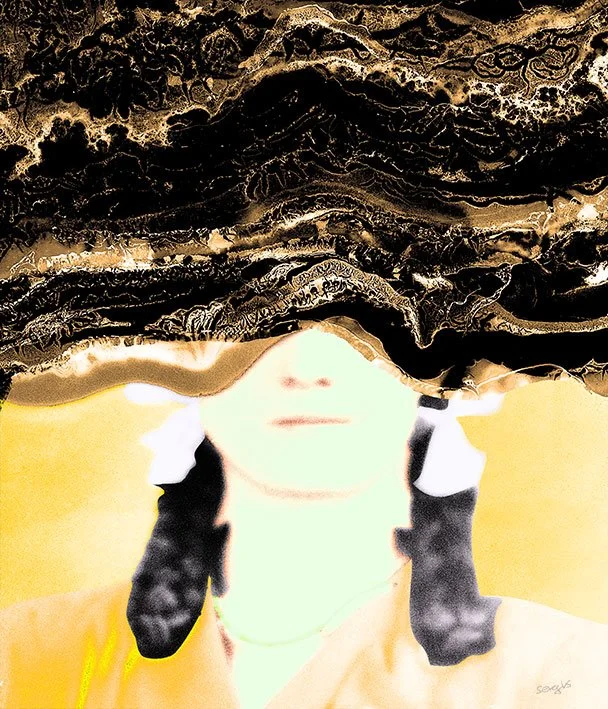
When this act is not performed by the artist but discovered and revealed through framing—as in Liminal Bloom—one could argue that Sergis’s minimal intervention is complemented by internal references to the history of art and portraiture. During viewing, one might recall Klimt, Frida Kahlo, Leonardo da Vinci, national engravings, photographs from a grandparent’s home—countless visual memories awakened by the representational void that can only be filled by the depth of each viewer’s own experience.
Almost Vanished Friends
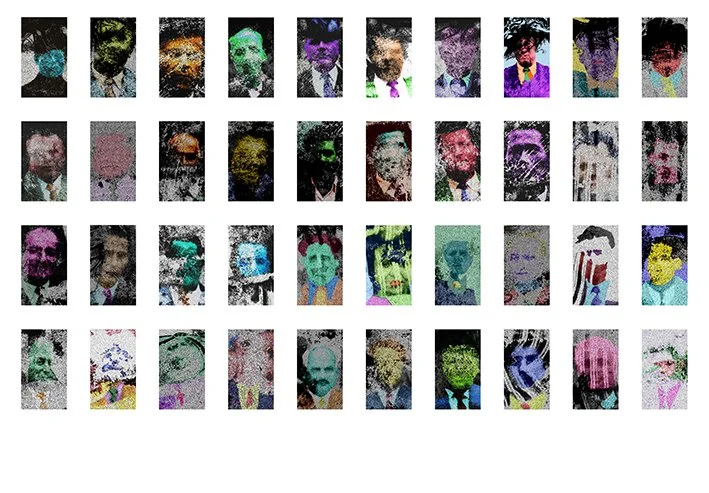
Through the scanning of a single photographic plate, Sergis isolated the faces of forty different men from a group portrait and presented them as nearly evaporated companions: Almost Vanished Friends. Spend as much time as you wish imagining the connections between them. What brought them together for this crowded photographic moment? A social event? An organization? A long friendship? How many still exist? How many have been claimed by time—not only as representations but as living beings? Do we remember them? Can we distinguish them? What binds them now as a group? Another cultural gathering… And Sergis’s choice to revive them becomes a celebration of friendship—a value he deeply cherishes.
Out of Nowhere
Near the entrance stands Out of Nowhere, functioning as both an introduction and a map of the entire exhibition. It is a wall installation of multiple frames of varying sizes that acknowledge the new freedom the artist enjoys once he stops staring directly at the figures in the photographs and instead begins to observe the marks time has etched upon them. Only then does he discover landscapes that defy linear scale or narrative: mountain ranges, rivers, microscopic aquatic systems, cartographies measured in millimeters, kilometers —or even light-years— where visual measurement merges with temporal measurement. Sergis has received a blessing from the archive. At an age when others begin to develop presbyopia, he has instead been granted a new pair of eyes.

Join the Party
Humor emerges most clearly in Join the Party, where four variations present the same young man, this time behind a mask concealing his identity. Beyond the new visual dimensions created by overlapping elements, the mask introduces playfulness, hinting at hidden passions and desires that images often conceal rather than reveal. The artist constructs a party where the depicted figures and we ourselves are co-guests; a temporal contraction that allows smiles and commentary. The characters become so provocative that we feel almost tempted to point at them, or, if alone in the gallery, even stick our tongue out playfully. As strangers wearing masks, we become familiar companions, guests at the same gathering, friends of the same host.

Digital Intervention
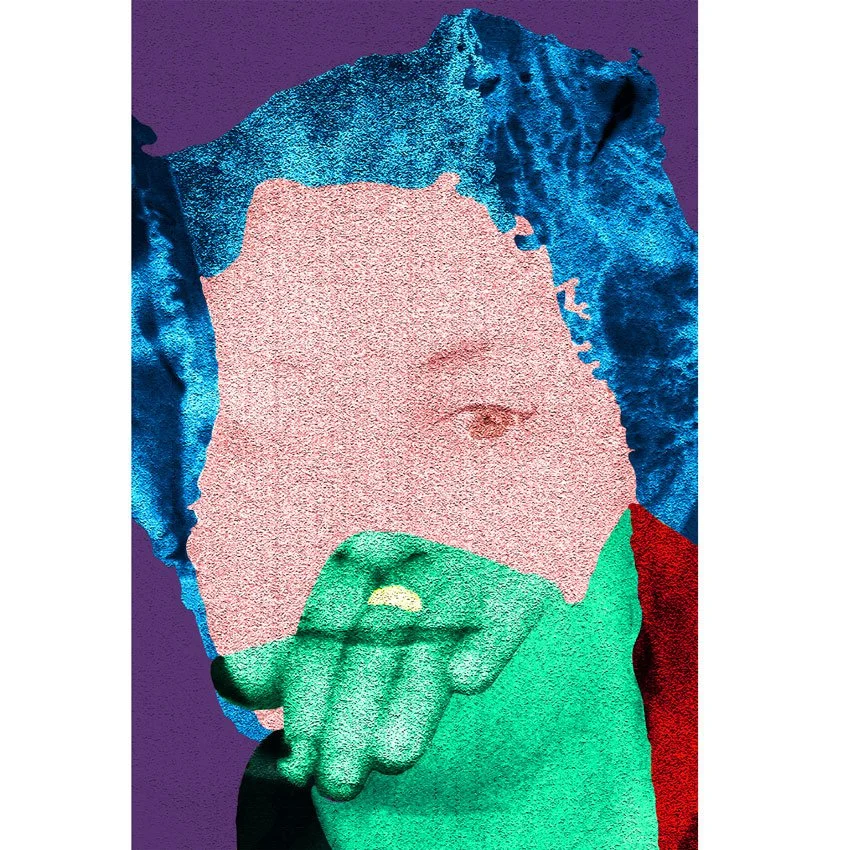
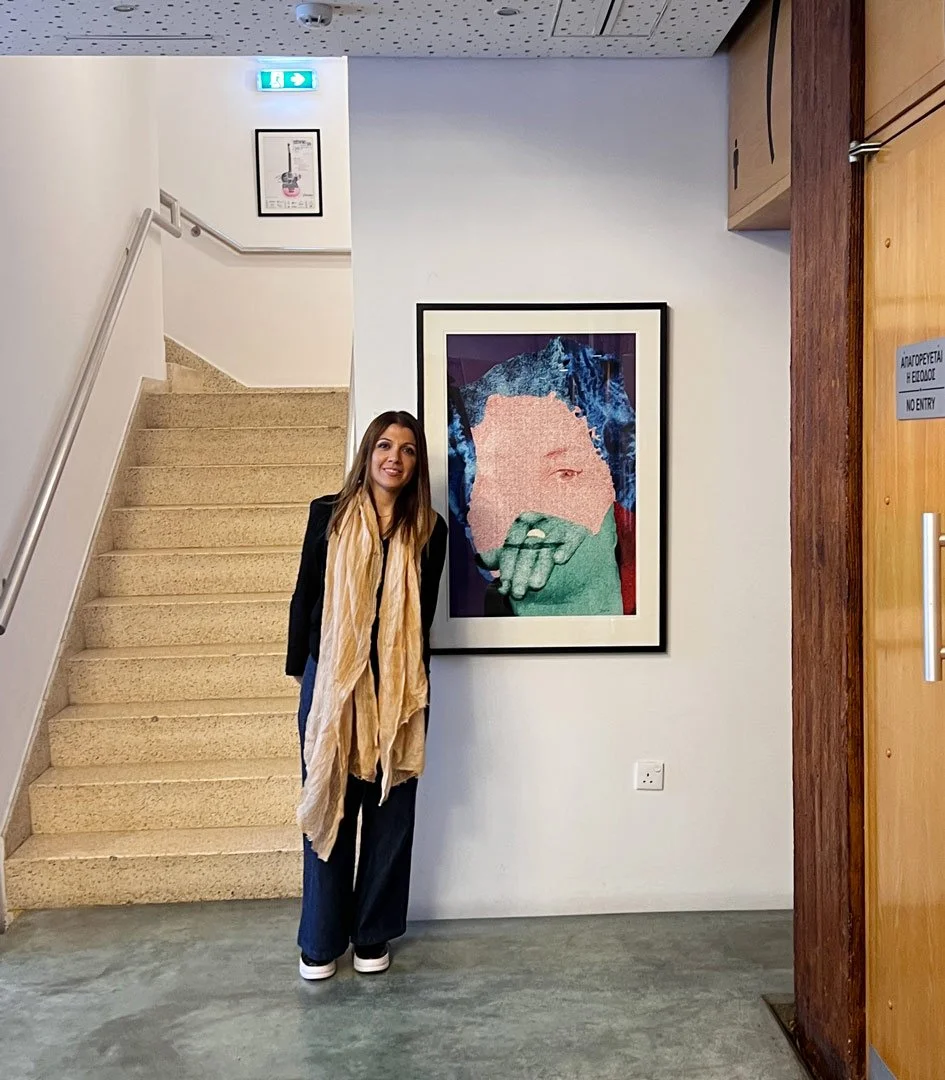
One must also acknowledge the evolution of Sergis’s digital interventions. The use of digital brushes to create covering patterns—which simultaneously generate texture and color—was initially easily recognizable as a digital device. Over time this technique evolved into something resembling analog noise. A work such as Era’s Elegance and The Phantom Hand demonstrates this transformation. This aesthetic shift is not accidental. Sergis’s obsessive examination of images—especially under extreme magnification in search of hidden details—exposes him to the chemical grain of analog photography and to the organic patterns of deterioration produced by time: humidity, dust, and corrosion. The digital texture he adds now enters into visual dialogue with this existing structure of noise.
It recalls something familiar to the generation of analog television: the static noise between broadcast signals, a noise that contains echoes of the universe’s primordial explosion. Through obsessive observation of photographic palimpsests, revealing chemical structures and organic decay, Sergis has developed an intuitive awareness of textures that evoke primordial creation. And as if that were not enough, the rest of his image manipulation —the seductive color applied to hair, the asymmetrical treatment of faces, the vivid red lips, the deliberately underexposed background— demonstrates a mature aesthetic understanding of the archive.
Rituals
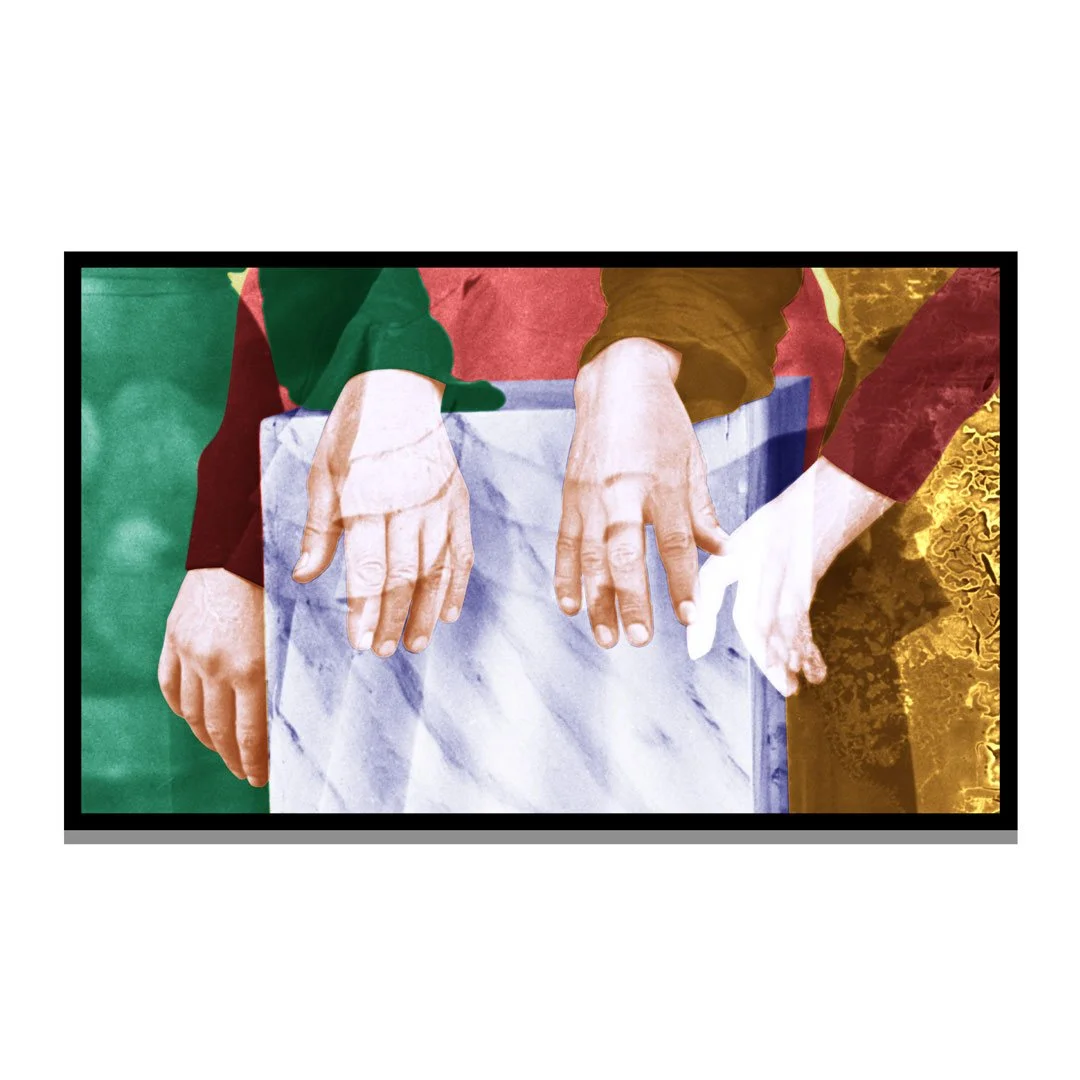
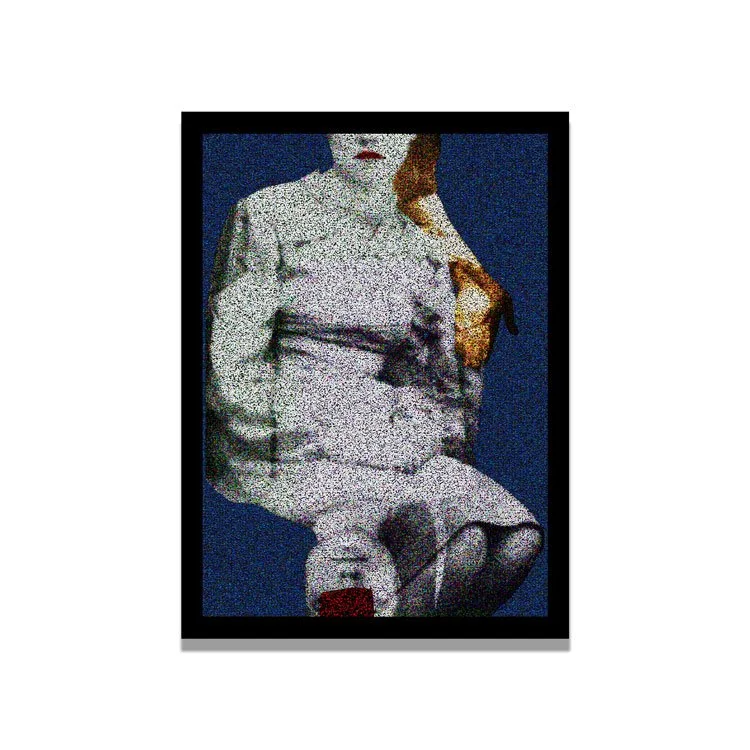
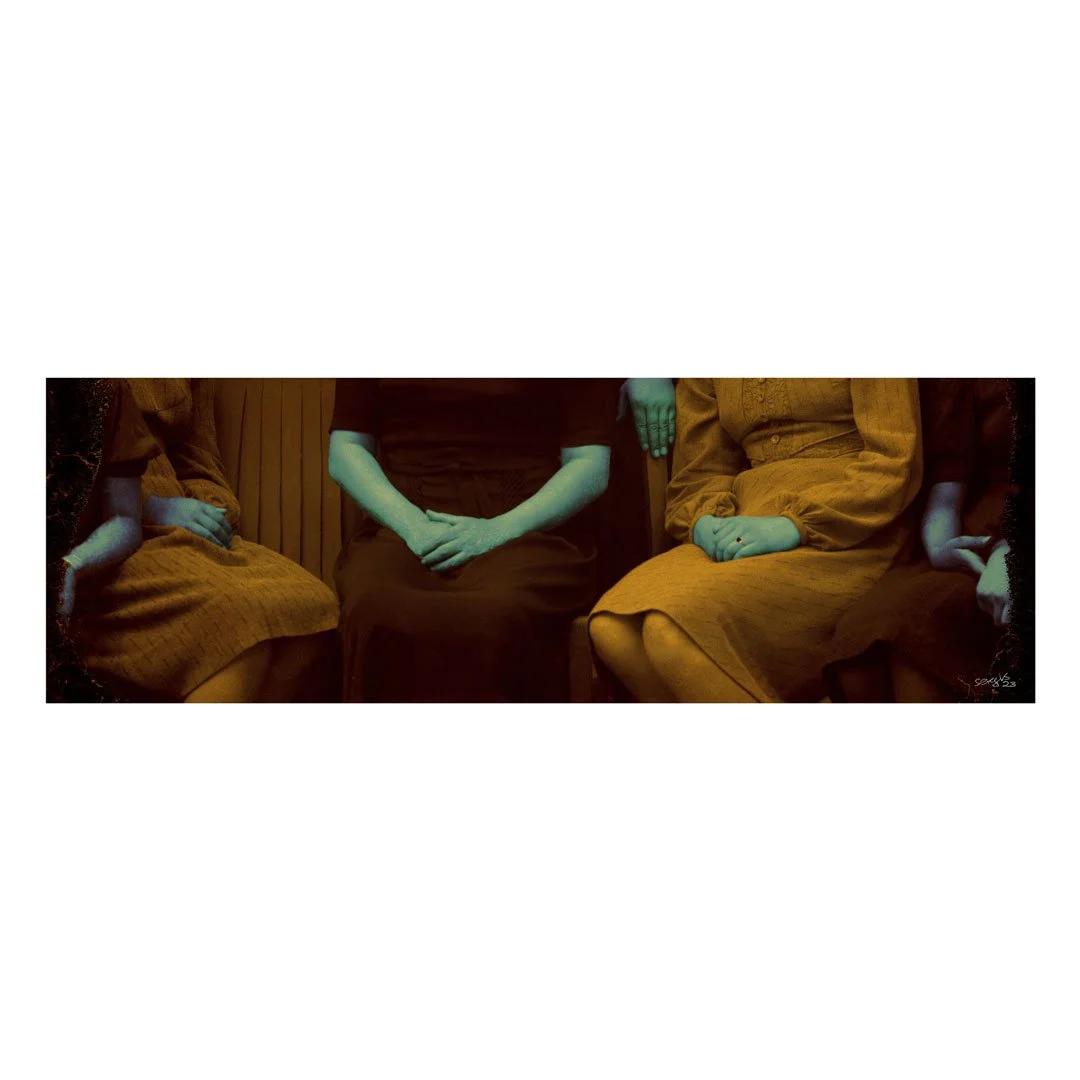
In his most recent works, Sergis no longer extracts only representations from the images. He isolates gestures, expressions, glances, smiles—moments he senses possess autonomous life. Among my favorite works are those belonging to a new series of rituals, where gestures and postures reveal actions, intentions, attitudes, and characters.
Bound hands, shy pairs of feet, broken body postures, the absence of identity, unnatural skin tones contrasting with harmonious garments—each element functions as a relic. Moments later, the lightness of contemporary colors applied to shoes, the impossibility of the scene, and the surreal layering of images return humor to the forefront, allowing us to view these images without fear of mortality.
In this futile confrontation with an archive of decay, ghosts, and oblivion, it is difficult for Sergis Adamos to emerge victorious. Yet his pursuit, to transform whatever remains into art, is noble. And the fact that he succeeds in doing so with current aesthetics, vibrant humor, evolving technique, renewed vision, and above all with continuous respect for the photographic archive, constitutes a remarkable artistic act.
-
Ό,τι απέμεινε, από τη μάχη ενός καλλιτέχνη ενάντια στο αρχείο…
Ο Σέργης Χατζηαδάμος σχεδόν απρόσμενα βρέθηκε να κηδεμονεί ένα πολυδιάστατα σημαντικό αρχείο, το φωτογραφικό αρχείο του Σπύρου Χαρίτου, φωτογράφου της πόλης της Πάφου και του κόσμου της σε μια εποχή που η φωτογραφία αποτελούσε αυθεντικά μέσο τεκμηρίωσης της κοινωνικής ζωής, του πολιτισμού και της κουλτούρας, της ιστορίας μιας κοινότητα ανθρώπων, από τη γέννηση μέχρι και τον θάνατο.
Και ενώ ο Πάφιος Σέργης προσπαθεί να βρεθεί ο οργανισμός εκείνος που θα διασώσει και θα αναδείξει σωστά το πολύτιμο αυτό αρχείο και την ιστορικο-κοινωνική του διάσταση, ο καλλιτέχνης Σέργης για χρόνια αναμετριέται με αυτό το αρχείο σε μια παράλληλη διάσταση που αφορά τα αισθητικά του χαρακτηριστικά και τις εικόνες που εξαϋλώνει από τις γυάλινες φωτογραφικές πλάκες ο ίδιος ο χρόνος.
Είχα την ευκαιρία να είμαι παρών κατά την αποθήκευση του αρχείου αυτού για τις ανάγκες μεταφοράς του από ένα υγρό και σκοτεινό υπόγειο της οικείας Χαρίτου στην Πάφο, όπου δυστυχώς μέρος του καταδύθηκε σε νερό μετά από καταρρακτώδεις βροχές, αλλά αυτό και όλο το υπόλοιπο αρχείο δέχτηκε τις διαδοχικές επιθέσεις της φθοράς που προκάλεσε η εποχιακή υγρασία, που σαν σαράκι κατατρώει τις άκρες των φωτογραφικών εικόνων και διεισδύει κάθε χρόνο πιο βαθιά προς το κέντρο, για να διεκδικήσει ακόμη περισσότερη αναπαράσταση.
Αυτές τις φωτογραφικές πλάκες, πλέον αμαλγάματα χωροχρόνου, ο Σέργης επιχείρησε να εκθέσει στο διαπεραστικό φως ενός ψηφιακού σαρωτή εικόνων και ήταν τότε που εικόνες ξαναήρθαν στην ζωή με ένα τρόπο εντελώς απροσδόκητο… Η τυχαία ένθεση πολλαπλών εικόνων, δημιουργεί οπτικά παλίμψηστα με διασυνδέσεις που υπερβαίνουν κάθε αρχική πρόθεση εικονογράφησης, αλλά ταυτόχρονα διατηρούν κάτι βαθύτερο που τις συνδέει και υπερβαίνει κατά πολύ την αρχειακή τους διάσταση και αξία.
Έτσι μπορεί να εξηγηθεί και το πρωταρχικό ένστικτο του καλλιτέχνη Σέργη, να επιτεθεί στην ίδια την αναπαράσταση και τα πρόσωπα που εικονίζονται. Μια ξεκάθαρη δήλωση πως δεν υπάρχει η πρόθεση να απαντηθεί το ποιοί ή το γιατί, μιας και προτεραιότητα είναι πλέον να οδηγηθούν οι θεατες των εικόνων που αναδύθηκαν, σε κατανόηση του πραγματικού τους δημιουργού: τον χρόνο. Ο χρόνος που μέσα από την φθορά, όχι μόνο εξαφανίζει σταδιακά τους ανθρώπους, αλλά και προσδίδει δικά του χαρακτηριστικά, οπτικά χαοτικά, που ομοιάζουν με δομή δακτυλίων ξυλώδους οργανισμού, με ικανότητα να φανερώσουν κοσμογονικές εκρήξεις, μετρούν χιλιετίες και καταγράφουν πλημμύρες και εποχές παγετώνων.
1
Βρέθηκε έτσι ο Σέργης, ενώ στην αρχή πίστεψε πως έχει να ανταγωνιστεί απλά ιστορικά πρόσωπα και την αναπαράσταση, κατά τη διαδικασία της καλλιτεχνικής μετουσίωσης του αρχείου, τελικά να ανταγωνίζεται και να παλεύει με τον ίδιο τον χρόνο και αυτού τα χαρακτηριστικά, όπως είναι η φθορά, η απουσία, η λήθη και το χάος.
Ακόμα και εάν πιστεύετε πως το αποτέλεσμα αυτής της “μάχης” είναι προκαθορισμένο, θα ήθελα να φέρετε στο μυαλό σας μια παρόμοια αναμέτρηση: αυτή του Ιππότη με τον Θάνατο σε παρτίδα σκακιού, στο κινηματογραφικό αριστούργημα Η Έβδομη Σφραγίδα του Ingmar Bergman. Εκεί που νομίζουμε πως η μάχη χάθηκε, ο Ιππότης εξομολογείται πως μια κίνηση του που έχει περάσει απαρατήρητη, θα του προσφέρει τη νίκη! Τι είναι αυτό που του προσφέρει το μεγάλο κίνητρο να νικήσει τον ίδιο τον Θάνατο; Μα φυσικά ο έρωτας και η αγάπη. Αλίμονο όμως, ο εξομολογητής είναι ο ίδιος ο Θάνατος, ο οποίος εντελώς ψυχρά του υποδεικνύει: “περίμενες στα αλήθεια να παίζω με δίκαιους κανόνες”;
Ο Σέργης, με θράσος γεννημένος στις 14 του Φλεβάρη, διατηρεί άσβεστο έρωτα για την τέχνη, αγαπά ανεξάντλητα το αρχείο. Για χρόνια αυτό αποτελεί κινητήρια δημιουργική δύναμη πίσω από τους ευφάνταστους τρόπους που εξερευνά, να μεταγράφει τα οπτικά του χαρακτηριστικά. Από “ακύρωση” των προσώπων, προχώρησε σε πιο ήπιες τεχνικές αλλοίωσης ή επέμβασης των χαρακτηριστικών, σε ανάδειξη στοιχείων, σε απομόνωση κομματιών, σε εναγκαλισμό της φθοράς, ακόμη και σε πλήρη αποδοχή του ελλιπούς.
Φτάνουμε έτσι στο σήμερα, χρόνια μετά την αρχική ανάδυση του αρχείου, που ο Σέργης προτείνει με την έκθεση του: “Ό,τι απέμεινε, καν’ το Τέχνη” κάτι πολύ ολοκληρωμένο και πλήρες. Και πριν καν επιχειρήσω να μιλήσω για τα ίδια τα έργα της έκθεσης, νιώθω πως αξίζει επίσης να αναφέρω πως κάθε έκθεση του Σέργη, μοιάζει όλο και περισσότερο με μια κοινωνική γιορτή. Ανοιχτή πρόσκληση, διευρυμένος ορίζοντας παρευρισκομένων, διάθεση ανεβασμένη, μουσική, άφθονο καλής ποιότητας κρασί και φαγητό. Μου θυμίζει παλιές εποχές -ειδικά στην Αθήνα- όταν μετά από επίσκεψη σε έκθεση τέχνης, έφευγες χορτασμένος από κουβέντες, γνωριμίες και καλή διάθεση. Μόνο η ευκαιρία συνεύρεσης για χάριν της τέχνης είχε αρκούσα σημασία για τον οικοδεσπότη καλλιτέχνη. Δεν είναι απλά το γεγονός ότι ο Σέργης το έχει καταλάβει αυτό, δεν είναι το πως ο ίδιος είναι πλέον έτοιμος να γιορτάσει το αρχείο, δεν είναι που ταιριάζει στην ιδιοσυγκρασία του, είναι που η τέχνη έγινε ολόκληρος ο κόσμος του και σε προσκαλεί να γίνεις μέρος του!
Μετά από την επίσκεψη μου λοιπόν στην έκθεση του Σέργη, ένιωσα την ανάγκη να γράψω για τα όσα είδα και ένιωσα, δε μου ζητήθηκε. Αυτό για εμένα είναι σημαντικό, γιατί ήταν η ένδειξη πως συνάντησα κάτι που δε μπορώ να προσπεράσω χωρίς να το εκφράσω. Τα έργα πολλαπλά, αποτέλεσμα μακροχρόνιας ενασχόλησης, διατρέχουν όλη αυτή την πορεία που περιέγραψα πιο πάνω, της αναμέτρησης του καλλιτέχνη με την αναπαράσταση και τον χρόνο αυτής.
2
Εισαγωγικό στην έκθεση το πολύ σύγχρονο: Emulsion Bloom ένα έργο που αναπαριστά μια αποτυχία ή καλύτερα τη στιγμή της αστοχίας. Βλέπετε ήδη πόσο ρευστό είναι το πέρασμα από την ίδια την αναπαράσταση, στον χρόνο της αναπαράστασης; Μια έγχρωμη κουκκίδα - το χρώμα αποτελεί επέμβαση του καλλιτέχνη που υποδεικνύει το φαινόμενο- δείχνει επακριβώς μια μεμονωμένη στιγμή αποτυχίας της χημικής επικάλυψης που δημιουργεί τη φωτογραφική εικόνα, η οποία αποκολλάται από τη γυάλινη πλάκα και αρχίζει να εμφανίζει τα δικά της διακριτά αισθητικά χαρακτηριστικά, τα οποία σε επόμενες περιπτώσεις θα δούμε πως αρχίζουν να καταλαμβάνουν επιθετικά ολόκληρες τις εικόνες. Συνειρμοί που φέρνουν στο μυαλό συμπαντικούς σχηματισμούς, γαλαξίες ή και διαστημικές καταβόθρες, φέρνουν τον θεατή αντιμέτωπο με κλίμακες χώρο-χρόνου που δύσκολα γίνονται αντιληπτές. Και σαν αποτέλεσμα, με τις στιγμές εκείνες που είναι γενεσιουργές, παρά τη φαινομενικά αρχική τους καταστροφική διάσταση. Πριν λοιπόν ο Σέργης φτάσει σε αυτό το στάδιο αποδοχής της οπτικής αστοχίας, έπρεπε να διανύσει ο ίδιος μεγάλες (δι)αισθητικές αποστάσεις… Πιστέψτε το!
Χαρακτηριστική έκφραση της προσπάθειας για ακύρωση της οπτικής ταυτότητας αποτελεί το: Mesmerised Beauty όπου η επέμβαση του Σέργη διαγράφει τα στοιχεία της ταυτότητας με επέμβαση στην ίδια την εκτυπωμένη εικόνα, με μέσα καλλιτεχνικά το ίδιο το πινέλο και τη μπογιά. Για οποιοδήποτε που ήρθε αντιμέτωπος με πιο πρώιμες προσπάθειες διαγραφής -σαν αποτέλεσμα καλλιτεχνικής παρέμβασης του Σέργη- είναι πλέον φανερό πως οι ποιότητες που χαρακτηρίζουν αυτή την ενέργεια, έχουν περάσει από διαδικασία επεξεργασίας που τις έχει τιθασεύσει και τους απέδωσε χαρακτηριστικά που μιμούνται την ίδια τη διαγραφή, όπως συμβαίνει από τον χρόνο στις φωτογραφίες.
3
Η επιλογή της μονοχρωμίας σε αυτή την περίπτωση, η έντονη υφή και η πολυπλοκότητα -υπό τύπον οργανικότητας- των πινελιών, αποδεικνύουν πως η εξέταση της πράξης της διαγραφής, καταναλώνεται σε πολύ περισσότερο βάθος από την απόκρυψη της εικόνας και την ακύρωση της αναπαράστασης. Συμβαίνει κάτι λοιπόν το παράδοξο, γιατί εν τέλει μια πράξη αφαίρεσης, καταλήγει να έχει προσθετικά νοήματα για το ίδιο το έργο.
Και όταν αυτή η πράξη δεν γίνεται από το καλλιτέχνη, αλλά την ανακαλύπτει / αποκαλύπτει σε εμάς, μέσα από την επιλογή ενός κάδρου, όπως το: Liminal Bloom τότε ισχυρίζομαι πως την ελαχιστοποιημένη συμμετοχή του Σέργη, συμπληρώνουν άλλες εσωτερικές αναφορές στην ιστορία της τέχνης και του πορτραίτου, που μπορούν να μας αναγκάσουν κατά τη θέαση να ανακαλέσουμε μνήμες από Klimpt, και Frida, και DaVinci, και εθνικά χαρακτικά, φωτογραφίες από το σπίτι των παππούδων, και τόσα άλλα που μπορούν να ξυπνήσουν όταν παρουσιάζεται το αναπαραστασιακό κενό που μπορεί να γεμίσει μόνο από τον πλούτο και το βάθος των εμπειριών του κάθε θεατή ξεχωριστά που βιώνει το έργο τέχνης.
Πλάι στην είσοδο, ένα έργο που λειτουργεί εισαγωγικά, σαν χαρτογράφηση και εγχειρίδιο ολόκληρης της έκθεσης, το: Out of Nowhere.
Είναι μια επιτοίχια εγκατάσταση πολλαπλών και διακριτών σε μέγεθος κάδρων που αποτελούν παραδοχή αυτή της νέας ελευθερίας που απολαμβάνει πλέον ο καλλιτέχνης από τη στιγμή που σταματά να κοιτάζει κατάματα τις φιγούρες στις φωτογραφίες και αρχίζει να παρατηρεί με καθαρό βλέμμα τα σημεία που χάραξε ο χρόνος, Μόνο τότε ανακαλύπτει πως διακρίνει μια σειρά από τοπία που αψηφούν συνθήκες γραμμικής
4
κλίμακας ή αφήγησης, για να προτείνει πέρα από μια σειρά κρυμμένων προσώπων, τις οροσειρές, τα ποτάμια, εκ των έσω μικροσκοπικά υδάτινα συστήματα, χαρτογραφήσεις μιλιμέτρων, χιλιομέτρων ή ακόμη ετών φωτός, εκεί που ακόμη μια φορά οι μετρήσεις οι εικονογραφικές συγχέονται με τις χρονομετρικές. Ο Σέργης έχει λάβει ευλογία από το αρχείο. Σε μια ηλικία που υπόλοιποι άνθρωποι αποκτούν πρεσβυωπία, αυτός έχει λάβει καινούργιο ζευγάρι μάτια.
Έχει έτσι ενημερωθεί ο θεατής για τα όσα απροσδόκητα μπορούν να προκύψουν από μια και μόνο σάρωση εικόνων του αρχείου, από ένα και μόνο ψηφιακό παλίμψηστο. Και ενώ μια τέτοια συνειδητοποίηση μπορεί να αποτελέσει αβάσταχτο βάρος, τον Σέργη σώζει το χιούμορ που διαθέτει, που του επιτρέπει με επίπεδα ελαφρότητας να ψάχνει μέσα σε εικόνες και να βρίσκει τι να μας προτείνει να κοιτάξουμε και πως. Μέσα από ένα ομαδικό πορτραίτο που και στην πραγματικότητα ο χρόνος προσπαθεί παράλληλα να ξεκάνει, ξεχωρίζει τα πρόσωπα σαράντα διαφορετικών ανδρών και τα παραθέτει ωσάν σχεδόν εξαϋλωμένους φίλους: Almost Vanished Friends. Αφιερώστε όσο χρόνο θέλετε να σχεδιάσετε τις μεταξύ τους διασυνδέσεις, τι ήταν αυτό που τους έφερε μαζί στο πολυπληθές φωτογραφικό ενσταντανέ. Μήπως ένα κοινωνικό δρώμενο, μια οργάνωση, μια μακρόχρονη φιλία; Πόσοι από αυτούς υπάρχουν ακόμη και πόσους ο χρόνος τους έχει διεκδικήσει, όχι μόνο σαν αναπαράσταση αλλά σαν ύπαρξη; Τους θυμούνται; Τους ξεχωρίζουν; Και τι είναι τούτο που τους συνδέει αυτή τη στιγμή σαν ομάδα… Ένα άλλο δρώμενο, πολιτιστικό. Και η επιλογή του Σέργη να τους ξαναζωντανέψει και να υμνήσει τη φιλία τους, αξία που ο ίδιος τόσο εκτιμά βαθιά.
5
Το χιούμορ που προκύπτει τόσο αμηχάνευτα και μαζί την ουσιαστική πρόσκληση που μας απευθύνει ο Σέργης φανερώνει φυσικά και το: Join the party, στο οποίο τέσσερις εκδοχές μας παρουσιάζουν τον ίδιο νεαρό άνδρα, αυτή τη φορά πίσω από μια μάσκα, σαν στοιχείο απόκρυψης της ταυτότητας. Σαν να μην αρκούν μόνο οι νέες διαστάσεις που φέρνει στην εικόνα η υπέρθεση των στοιχείων, με την προσθήκη της μάσκας ο καλλιτέχνης δημιουργεί μια παιχνιδιάρικη εκδοχή, κλείνει το μάτι σε συσχετίσεις και πάθη και πόθους, που γνωρίζει πως οι εικόνες ήταν πιο ικανές να κρύψουν, αντί να φανερώσουν. Δημιουργεί αφορμές για πειράγματα, όπως οι κοινωνικές συνθήκες της εποχής των φωτογραφιών απαιτούν, φτιάχνει πάρτυ στο οποίο οι εικονιζόμενοι είναι συμπροσκεκλημένοι μαζί με εμάς, μια συνθήκη χρονικής συστολής που τα τερτίπια στην εικόνα, δίνουν σε εμάς δικαίωμα για χαμόγελα και σχολιασμό. Είναι τόσο προκλητικοί οι χαρακτήρες που αποκτούμε το δικαίωμα να σηκώσουμε το δάχτυλο και να τους καταδείξουμε, αν ήμασταν μόνοι μας στην αίθουσα ίσως να τους βγάζαμε και τη γλώσσα περιπαιχτικά… Γιατί σαν άγνωστοι με μάσκες, είμαστε ποια οικείοι, θαμώνες στο ίδιο πάρτυ, προσκεκλημένοι του ίδιου οικοδεσπότη, φίλοι.
Κάτι στο οποίο πρέπει επίσης να σταθώ, είναι η εξέλιξη στην ποιότητα της ψηφιακής παρέμβασης από τον Σέργη. Η χρήση digital brushes για τη δημιουργία μοτίβων κάλυψης των εικόνων που λόγο του τρόπου που εφαρμόζονται αποτελούν ταυτόχρονα και στοιχείο δημιουργίας textures / υφών, αλλά και χρωματισμού της εικόνας, στα αρχικά στάδια της επεξεργασίας σαν εργαλείο, ήταν πιο εύκολα αναγνώσιμη από τον θεατή και ομοίαζε με αναγνωρίσιμο ψηφιακό μοτίβο. Με την πάροδο του χρόνου, παρατήρησα την εξέλιξη αυτού του εργαλείου σε βαθμό που θυμίζει ένα είδος αναλογικού θορύβου. Παραθέτω την πιο κάτω εικόνα, με τον τίτλο: Era’s Elegance and The Phantom Hand η οποία έχει τύχει επεξεργασίας όπως περιγράφω πιο πάνω.
6
Δεν είναι τυχαίο που ο Σέργης μετακινήθηκε προς αυτήν την αισθητική, γιατί η συνεχής θέαση των εικόνων -ειδικά σε συνθήκες υπερβολικής μεγέθυνσης- στην προσπάθεια να εξάγει νέες κρυμμένες λεπτομέρειες, τον εκθέτει τόσο στον χημικό κόκκο της αναλογικής φωτογράφισης οποίος γίνεται μια ιδιότυπη υφή της εικόνας, αλλά και στην χαρακτηριστική αισθητική μέρους της φωτογραφίας η οποία εμφανίζει τα οργανικά σημεία φθοράς από τον χρόνο -υγρασία και σκόνη, κ.ο.κ.-. Η ψηφιακή υφή που προσθέτει ο καλλιτέχνης, βρίσκεται σε οπτικό διάλογο με την προϋπάρχουσα δομή θορύβου. Και η αναλογική ή οργανική φύση αυτού, επειδή έχει να κάνει ακριβώς με την έκφραση του μικροσκοπικού ως χημική διαδικασία και του χρονικού ως διαδικασία παλαίωσης, μου θυμίζει ένα άλλο “φάντασμα” που συναντούσαμε συχνά ως γενιά της αναλογικής τηλεόρασης. Τον αναλογικό θόρυβο στα ενδιάμεσα της κανονικής εκπομπής κινούμενων αναπαραστάσεων -των καναλιών τηλεοπτικών σταθμών- που περιλαμβάνει και απομεινάρια του απόηχου μιας συμπαντικής έκρηξης, της αρχικής δημιουργίας του κόσμου.
Η εμμονική θέαση των φωτογραφικών εικόνων, σε αυτή την μορφή του παλίμψηστου με την επιπλέον διάσταση της οργανικής δομής της φθοράς, σε μεγεθύνσεις που φανερώνουν και τη χημική δόμηση που κάνει δυνατή την αναπαράσταση, έχει υποσυνείδητα πριμοδοτήσει τον Σέργη με διαισθητική επίγνωση της υφής που παραπέμπει σε δημιουργία αρχέγονη. Και, ωσάν να μην έφτανε αυτό, όλα τα υπόλοιπα στοιχεία της επεξεργασίας της εικόνας, το ελκυστικό χρώμα που προσθέτει στα μαλλιά, ο ασύμμετρος χειρισμός των προσώπων, τα κατακόκκινα γυναικεία χείλη, το αποφασιστικά υποεκθεμένο παρασκήνιο, η πλήρης σειρά επιλογών, δείχνει πως βρίσκεται σε ένα ώριμο στάδιο αισθητικής αντίληψης του αρχείου.
Τελευταίο του εγχείρημα; Δεν εξάγει μόνο αναπαραστάσεις από τις εικόνες, πλέον βρίσκει στιγμές και χειρονομίες, εκφράσεις, ματιές, χαμόγελα που ο Σέργης έχει υποψιαστεί πως έχουν αυτόνομη ύπαρξη και ζωή. Αγαπημένα μου έργα -μέρος αυτών των εθιμοτυπικών ή rituals όπως τα αποκαλεί, που φανερώνουν δράσεις, κινήσεις, φερσίματα, προθέσεις, στάσεις, χαρακτήρες- οι δύο συλλογές από μέλη που ξεχώρισε μέσα σε κάδρα, μέρος νέας σειράς έργων που συνεχίζει να του προσφέρει ανεξάντλητα αυτό το φωτογραφικό αρχείο…
7
Τα δεμένα χέρια, τα συνεσταλμένα ζευγάρια από πόδια, η σπαστή στάση του σώματος, η έλλειψη ταυτότητας, το αφύσικο χρώμα του δέρματος, σε αντιδιαστολή με το ταιριαστό χρώμα φορέματος, κάθε στοιχείο αυτής της εικόνας λειτουργεί ώστε να την κάνει ενθύμιο!
Και αμέσως μετά η ελαφρότητα επιλογής σύγχρονων χρωμάτων για τα παπούτσια, το αδύνατο της σκηνής και το σουρεαλιστικό της υπέρθεσης των εικόνων, φέρνουν όλα μαζί ξανά στο προσκήνιο το χιούμορ και μας επιτρέπουν να αντικρίσουμε τις εικόνες χωρίς φόβο θνητότητας.
Σε αυτή την μάταια αναμέτρηση με ένα αρχείο φθοράς, φαντασμάτων και λήθης, είναι δύσκολο να εξέλθει νικητής ο Σέργης Αδάμος. Αλλά η επιδίωξη του, ό,τι απέμεινε να το μετουσιώσει σε τέχνη, είναι τουλάχιστον ευγενής. Και το γεγονός πως επιτυγχάνει να το κάνει με καίρια αισθητική, με ζωντανό το χιούμορ, με εξέλιξη της τεχνοτροπίας, με νέα ματιά στις εικόνες και προπάντων με διαρκή σεβασμό προς το φωτογραφικό αρχείο, είναι μια σπουδαία καλλιτεχνική πράξη.
Χαράλαμπος Χαραλάμπους (Παρασκευή, 13 Φεβρουαρίου 2026)
8